
The complete guide
How To Choose A Silk Bonnet That Actually Stays On
The problem with waking up to flattened hair
You go to bed with your hair looking fine. Eight hours later it has been dragged across a pillowcase a few hundred times, pushed into odd shapes, and the curls or the blow-dry you were pleased with have gone. Nothing dramatic happened. Your head just moved, and the pillow did not let your hair move with it.
That is friction. Cotton bedding has a rough surface at the fibre level, and hair catches on it. Each small catch pulls a strand sideways, out of place, and into the tangle it was not in when you lay down. Add a cotton cap into the mix and you have swapped one rough surface for another.
A silk bonnet solves this by changing what your hair sits against. Silk is smooth, so hair slides over it rather than snagging. Put the hair inside a cap and you also stop it being spread across the bed in the first place. The two things together are the whole point.
What a single layer changes
Most bonnets you see online are built from two layers. There is an outer fabric, a lining, and sometimes a bit of padding in between to give the cap a rounded shape. That construction holds its form nicely and looks substantial in photographs.
It also sits heavier on your head, and it holds heat.
This bonnet takes the other approach. One thin layer of 100% mulberry silk, nothing behind it. The fabric drapes down against the shape of your hair instead of hovering above it in a dome. It weighs almost nothing. In a warm bedroom, or in summer, the difference is noticeable within minutes of putting it on.
The trade-off is honest. A single layer does not hold a sculpted shape the way a lined bonnet does. If you want a cap that sits up like a chef's hat regardless of what is underneath, this is not that. If you want the lightest thing you can put between your hair and the pillow, it is.
Why the extra large cut matters more than you think
Size is where most bonnets fall down for people with a lot of hair.
Picture what happens when you push long hair or a set of braids into a cap that is too small. The hair has nowhere to go, so it gets pressed flat against the scalp and folded into whatever space is left. You wake up with a crease where the edge of the bonnet sat, and the volume you had is gone. The cap did its job on friction and failed on everything else.
An extra large cut gives the hair somewhere to sit. You gather it loosely, let it coil or pile naturally, and tuck the whole lot up inside. Nothing is being compressed. In the morning the shape is still roughly the shape you went to bed with, which is what people actually want from the best silk bonnet for long hair.
This matters for braids, twists and locs in particular, because those take up real volume and do not squash down the way loose hair does. If you have been finding caps too tight across the back of the head, that is a sizing problem rather than a silk problem.
Elastic, tie, or both
Three ways of fastening a bonnet exist and they are not equal.
Elastic alone is the cheapest and the most common. It works until it does not. Too tight and you wake up with a line pressed across your forehead. Too loose and the cap is on the floor by three in the morning. Elastic also tires out, so a cap that fitted well in month one may be slack by month six.
A tie alone gives you full control but takes more fiddling, and a knot sitting against the back of your head is not comfortable for everyone.
This bonnet uses both. The elastic edge does the basic work of holding the cap against your head, and the tie lets you set the tension on top of that. On a night when your hair is freshly washed and conditioned, and taking up more room than usual, you let the tie out. On a night when you want it firm because you move around a lot, you pull it in. That flexibility is why an adjustable silk bonnet tends to still be in use a year later, while a plain elastic one gets abandoned.
A quick fitting tip. Once it is on, slide a finger under the edge. If it goes in easily but the bonnet does not shift when you turn your head, you have the tension right.
Who this suits
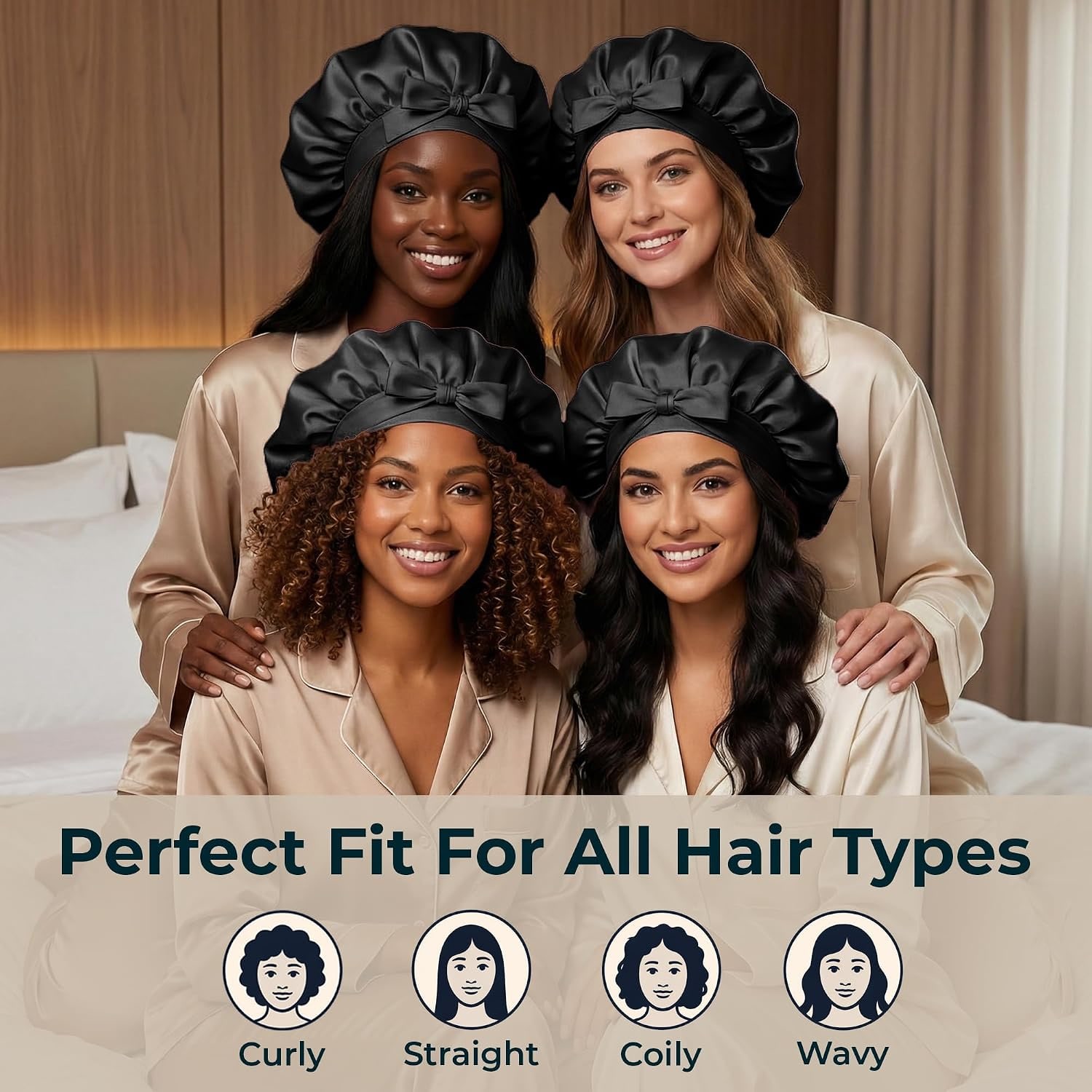
People with long hair who are tired of untangling it every morning. People with curls or coils who want to keep a style going for a second and third day. Anyone with braids, twists or locs that need containing overnight. People who sleep warm and have given up on padded bonnets because they felt like wearing a hat to bed.
It also suits anyone who wants something plain. Solid black, no print, no logo across the front. If you share a house, or you travel, or you simply do not want a bright patterned thing on your bedside table, black is the practical pick.
Who it suits less well. If you want a stiff, structured cap that keeps a defined dome shape, a double-layer bonnet does that better. And if you have very short hair, you may find a full-size cap more fabric than you need, though plenty of people with short hair still like one for keeping a fresh cut tidy.
How to look after it
Silk rewards gentle handling and punishes shortcuts, and the rules here are short.
Hand wash only. Cool water, a small squeeze of a detergent made for delicate fabrics, and a few minutes of light swishing. Do not scrub, do not wring, do not twist it into a rope to get the water out. Lay it on a towel, roll the towel up, press, then unroll and reshape the bonnet while it is damp.
Dry it flat, in the air, away from radiators and away from direct sunlight. Heat is what turns soft silk stiff and dull, and a tumble dryer will do that faster than anything else.
Wash it every week or two as a rough guide. If you use oils or rich creams on your hair at night, those transfer into the fabric and you will want to wash more often. Some people buy two caps for exactly that reason, so one can dry while the other is in use.
Wash it on its own for the first few goes, since it is a dark dyed fabric. If it needs pressing after drying, the coolest iron setting on the reverse side is enough.
Using it with the rest of your routine
A bonnet and a silk pillowcase do different jobs. The bonnet contains the hair. The pillowcase gives a smooth surface for your face, your neck, and any strands that work their way out. Using both is not overkill, it is just covering two different contact points.
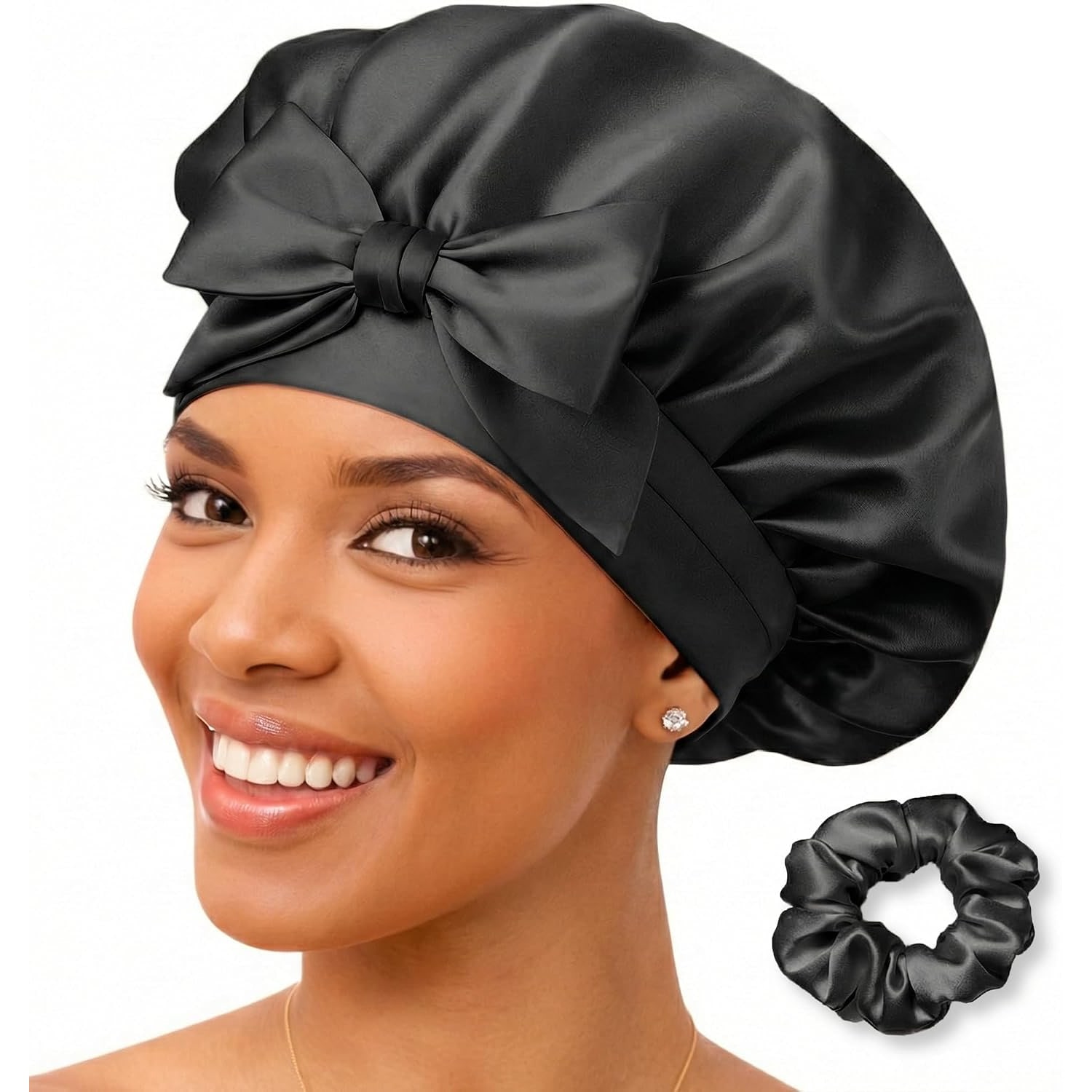
The matching scrunchie shown with the bonnet has a role too. Tying hair back loosely before the cap goes on stops it unravelling inside and makes it easier to gather everything in one go. Loose is the key word. A tight band at the back of your head for eight hours creates its own crease.
If you are protecting a specific style, put the bonnet on while the style is still set rather than after you have been lounging about in it for an hour.
The short version
This is a plain black cap in 100% mulberry silk, built as one thin layer so it stays light on your head. It is cut extra large so long hair, thick hair and braids have room to sit without being squashed. An elastic edge plus a tie means you set the fit yourself, which is the difference between a bonnet that stays on and one that ends up under the bed. A matching scrunchie comes with it. Hand wash only, dry flat, keep it away from heat.
If you sleep warm, or you have tried a padded bonnet and found it too much, this is the lighter version of the same idea.