
The complete guide
How to Choose and Wear a Long Silk Scarf
The problem with most scarves
Most people own a drawer full of scarves and wear two of them. The rest are either too short to do anything interesting with, too bulky to fit under a coat collar, or in a colour that only works with one outfit. They get bought in a hurry, worn twice, then live in the back of a wardrobe.
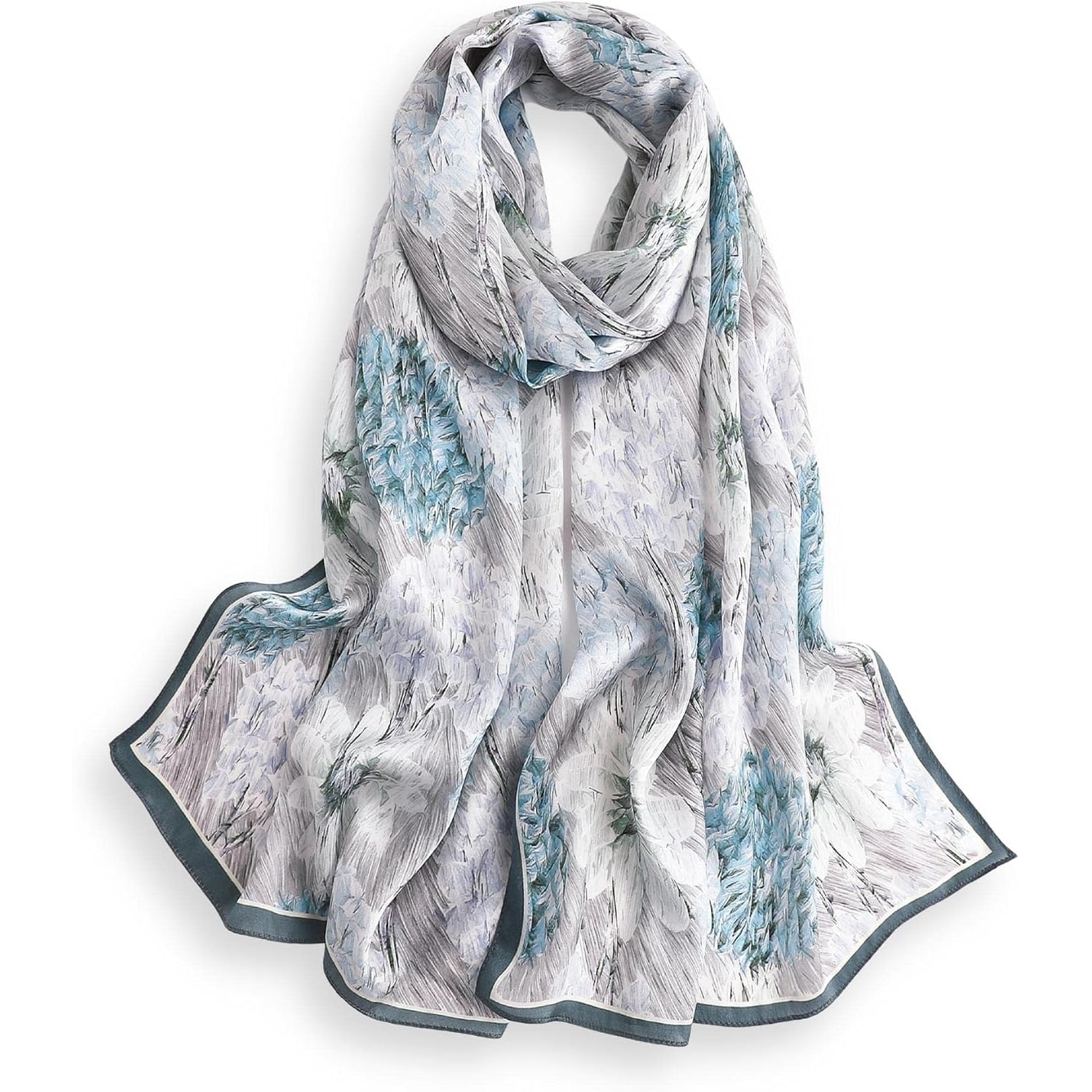
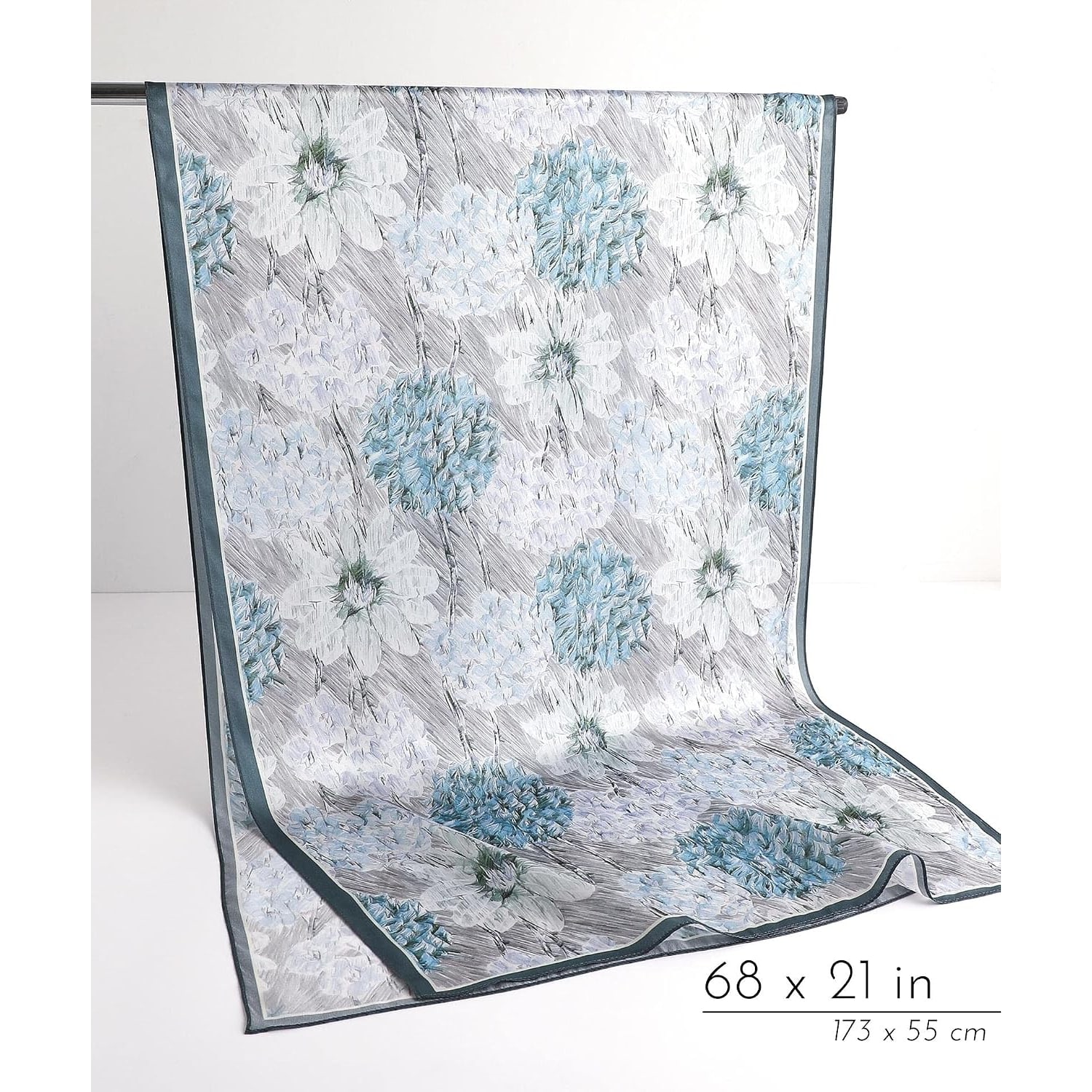
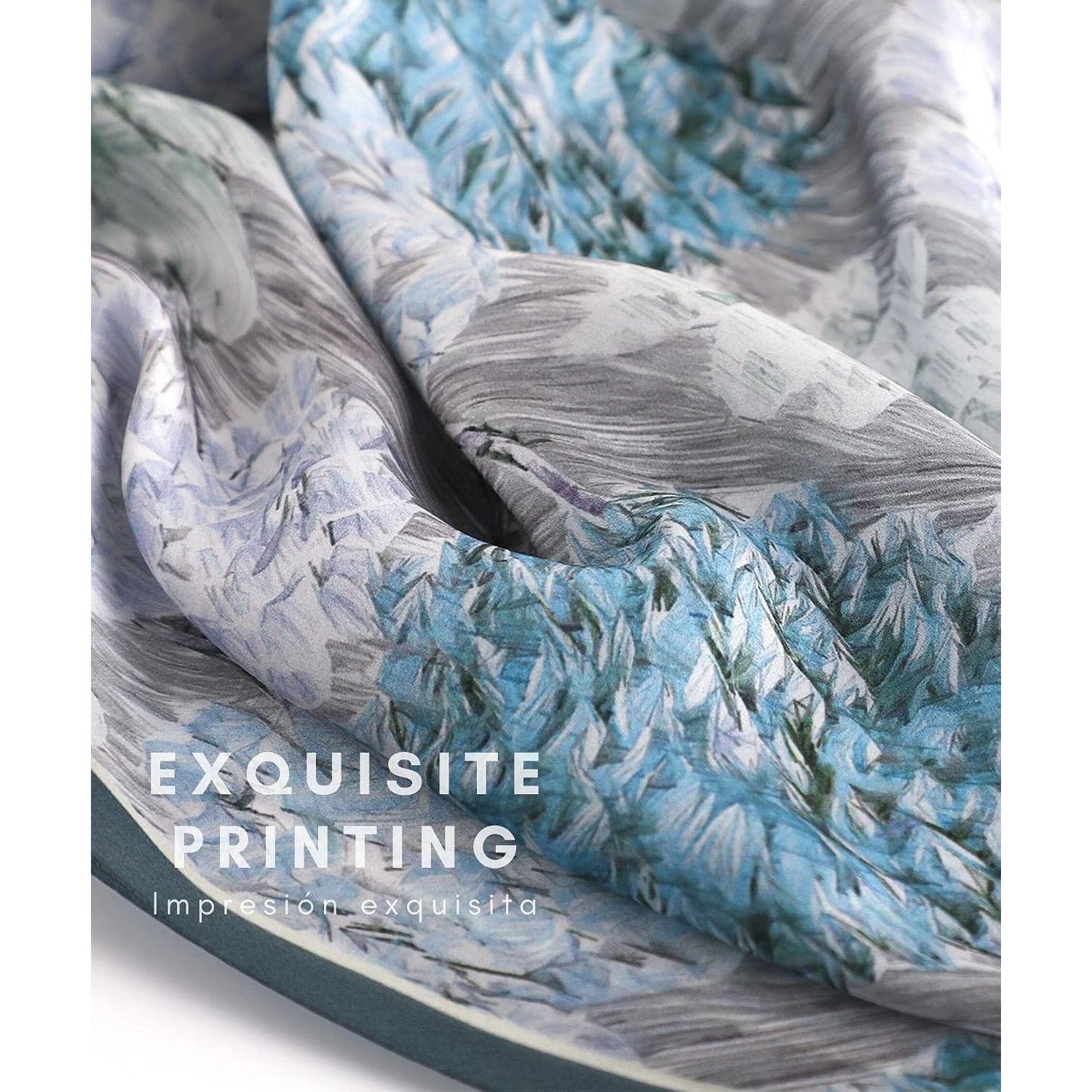
A long silk scarf solves this, but only if you get two things right: the length and the palette. This one is 173 x 53 cm (68 x 21 inches) in a hydrangea blossom print of soft grey and blue. Those two numbers and that colour choice are doing most of the work.
Why length changes everything
A 90 cm square scarf can be folded into a triangle and tied at the neck. That is about it. Anything more ambitious runs out of fabric.
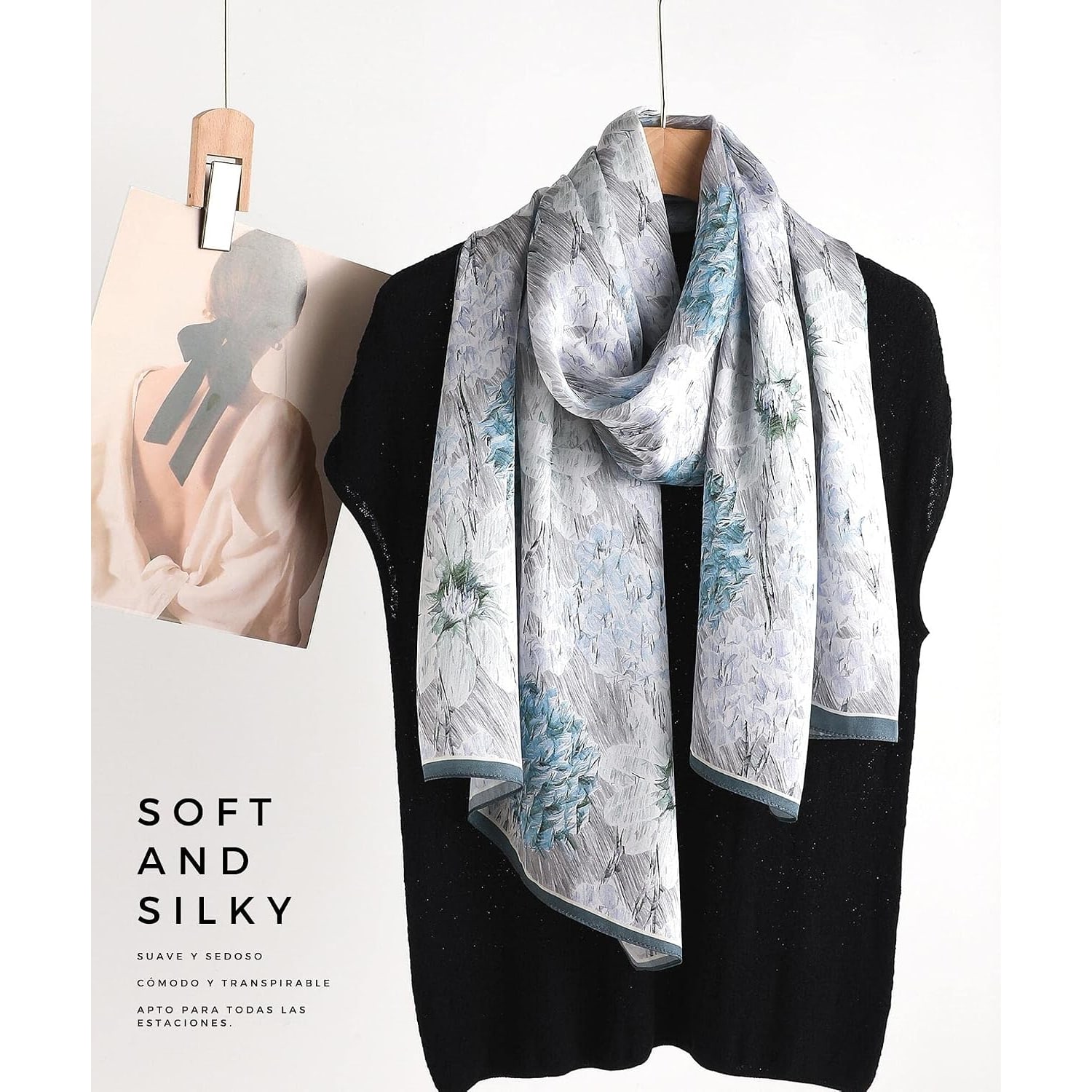
At 173 cm you have options. You can loop it once around the neck and let both ends hang to mid-chest. You can loop it twice for a fuller, warmer collar with short tails. You can open it out and drape it across the shoulders as a light wrap over a sleeveless dress. You can fold it lengthways into a band and tie it over the head, or around a ponytail, or through belt loops.
The 53 cm width matters too. Narrower scarves look thin when draped open. Wider ones get bulky when knotted. This sits in the middle, which is why the same piece can act as both a neck scarf and a shoulder wrap without looking wrong in either role.
What mulberry silk actually is
Silk gets used loosely as a word. Plenty of items described as silky are polyester with a shine on them. Mulberry silk is specific.
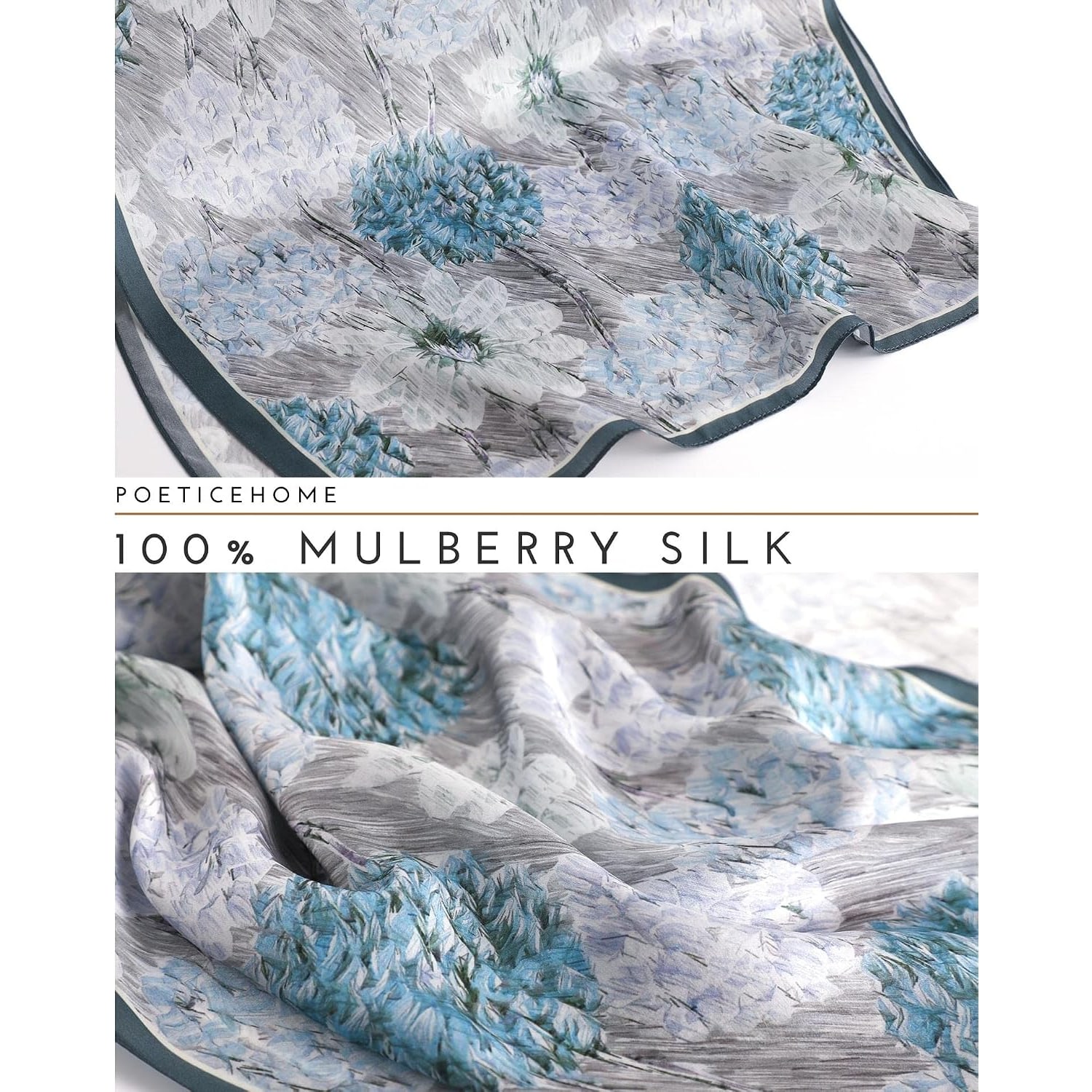
Silkworms raised on a single diet of mulberry leaves produce a long, uniform filament. That consistency is what gives the finished fabric its smooth hand and even drape. Shorter, mixed fibres produce a rougher yarn and a fabric that pills and looks tired sooner.
You can usually feel the difference. Real silk warms to your skin temperature within a minute or two of wearing it. Synthetic imitations stay slightly cool and slightly slippery and never quite settle. Silk also drapes in soft folds rather than standing away from the body in stiff creases.
Smoothness has a practical side. Hair and skin slide over silk with less friction than they do across cotton or wool. That is why people who care about a blow dry reach for a silk head covering on a windy day, and why a silk scarf rarely leaves the neck feeling scratched after a long afternoon.
Reading the print
Hydrangea blossom in grey and blue is a deliberately quiet choice. The flower clusters give the fabric texture and movement without any single loud colour taking charge.
The practical benefit is matching. Grey works with everything. Blue is close enough to denim and navy to look intentional and far enough from them to still register as a separate layer. Put this over a black coat and it lifts it. Put it over a cream jumper and it anchors it. Put it with jeans and a white shirt and it finishes the whole thing.
Compare that with a scarf in a single strong colour, say a bright coral. It looks excellent with three items in your wardrobe and odd with the rest. A muted floral is the safer buy if you want something you reach for weekly rather than twice a year.
Who this suits
It suits anyone who wants one scarf that works across seasons. In spring and autumn it is a neck layer. In summer it is a shoulder cover for restaurants and evening walks. In winter it goes under a coat collar as an extra layer that adds no bulk to the sleeves.
It suits people who travel light. Silk folds down to almost nothing and weighs very little, so it slips into a handbag or a carry-on without argument and comes out ready to wear after a shake.
It suits gift buyers. There is no size to get wrong, the palette is broadly flattering, and silk reads as considered rather than generic. If you are looking for the best silk scarf gift for someone whose taste you only half know, a muted floral in a neutral palette is the low-risk answer.
It is less right for you if you want serious warmth. Silk is light and holds a little heat, but it is not wool. On a genuinely cold morning it belongs as a layer, not the main event.
How to wear it, in practice
For the simplest look, fold it in half lengthways, drape it behind the neck, pass the two loose ends through the loop at the other side and pull snug. That knot takes four seconds and stays put.
For a fuller collar, hold one end short, wind the long side twice around the neck and tuck the ends under the loops. This is the version that works best under a coat.
For a wrap, open it fully and lay it across the shoulders with equal lengths hanging at the front. If it slips, a small pin at the back (not through the silk, hooked under a bra strap) solves it.
For hair, fold lengthways into a band roughly 8 to 10 cm wide, lay it across the crown and tie at the nape. The length allows a knot plus tails, which you can tuck or leave visible.
Looking after it
The care instruction is hand wash only, and that is worth respecting.
Use cool water and a mild detergent made for delicates. Swirl it gently for a minute or two, do not scrub, and rinse until the water runs clear. Never wring or twist the fabric, as that breaks the filaments and leaves permanent creasing.
To dry, lay it flat on a clean towel, roll the towel up loosely to draw out the water, then unroll and dry the scarf flat on a fresh dry towel. Keep it out of direct sunlight and away from radiators. Heat and sun are the two things most likely to dull the colour.
If you want a crisp finish, iron on the lowest silk setting, preferably on the reverse side with a thin cloth in between. Most of the time steam from a bathroom does the job without an iron at all.
Two habits make a real difference. Put perfume and hairspray on first and let them dry before the scarf goes near your neck, because alcohol marks silk. And store it folded or rolled in a drawer rather than hanging on a hook, so the weight of the fabric does not pull the shape out.
Judging quality when you buy
Not every silk scarf is worth the money. A few checks help.
Look for a stated fibre content. This one is 100% mulberry silk, which is a clear, checkable claim rather than a vague word like silky.
Look at the dimensions. A long rectangle at 173 cm gives you genuine versatility. Anything under about 150 cm starts limiting what you can do with it.
Look at the print palette. Muted, multi-tonal prints match more clothes than single bold colours and tend to date more slowly.
And look at the care instruction. Hand wash only is normal for pure silk. A scarf that claims silk and offers a hot machine wash is usually telling you something about the fibre.
The short version
This is a 173 x 53 cm rectangle of 100% mulberry silk carrying a hydrangea blossom print in soft grey and blue. The length lets it work as a neck scarf, a shoulder wrap or a head covering. The muted palette means it matches most of what is already in your wardrobe rather than a narrow slice of it. Silk is smooth, so it sits comfortably against the neck and lets hair slide over it. Hand wash it, dry it flat, keep it out of the sun, and it will still look right in several years. If you want one scarf that does several jobs instead of five that each do one, this is the shape and the palette to pick.