

The complete guide
Silk Pillowcase Buyer's Guide, Momme Weight, Sizing And Care
The problem with the pillowcase you already own
Most of us never think about pillowcases. They come in the set with the duvet cover, they go on the bed, and that is the end of it. But you spend somewhere near a third of your life with your face pressed into one, and the fabric you choose has more effect than you would guess.
Standard cotton is a good, honest fabric. It breathes, it washes hot, it costs very little. The trade-off is texture. Woven cotton has a dry grip, and your skin and hair drag against it every time you turn over. That is why you wake with creases printed across your cheek and why long hair ends up matted at the back of the head. Nothing dramatic, just a small nightly friction that adds up.
Silk changes the surface, not the sleeper. The fibre is smooth along its whole length, so your face and hair slide over the fabric rather than catching. That is the entire mechanical argument for silk bedding, and it is the only one worth making. It is a smoother fabric. What you do with that is up to you.
What 19 momme actually tells you
Silk is sold by momme, written as mm, which is an old Japanese unit of weight. It measures how much a fixed area of the fabric weighs. Higher momme means more silk per square centimetre, which means a denser, heavier, more durable cloth.
Bedding silk usually lands somewhere between 16 and 25 momme. Below 16 you are into scarf and lining territory, where the fabric is light and pretty but thin enough to see through, and it tends to go limp after a handful of washes. Above 22 you get a heavy, luxurious hand and a price to match.
This pillowcase is 19 momme, which is the spot most people settle on. It has enough weight to hang properly over a pillow and sit still, enough density to survive weekly washing, and it does not cost what the very heavy weights do. If you are comparing cases across different sellers, momme is the single most useful number on the page. The maker here also lists a 600 thread count, though with silk, thread count varies in how it is counted between mills, so treat momme as your main guide.
Why both sides matter
Have a close look at cheaper silk pillowcases and you will often find silk on the top face only, with cotton or polyester on the reverse. It keeps the cost down, and the maker can still say silk on the label.
The trouble is practical. You turn a pillow over during the night. You flip it when the top side warms up. With a one-sided case, half the time you are sleeping on the cheap side. This one is 100% mulberry silk front and back, so it genuinely does not matter which way the pillow lands.
Mulberry silk, for the product details, refers to how the silkworms were fed. A diet of mulberry leaves only produces a long, even, uniform filament, and long filaments are what give the woven fabric its smooth feel and consistent sheen. It is the standard grade for bedding.
Getting the size right
The measurement here is 50 x 75 cm, written on the maker's details as 51 x 76 cm, or 20 x 30 inches in old money. That is the UK standard pillowcase size, so if your bedding came from a British shop, it is very likely the right fit.
Before you order, measure the pillow you actually sleep on. Pillow sizes drift more than you would expect. Some memory foam pillows are deeper and wider than a traditional feather one. Some continental pillows are square, usually 65 x 65 cm, and a standard case will not stretch to those at all.
A case that is slightly too small will strain the seams and the zip, and you will feel the tension across the surface. A case that is far too large will bunch and crease, which loses you the flat smooth surface you paid for. Aim for a snug fit where the silk sits flat and taut without pulling.
The closure is not a small detail
This pillowcase uses a hidden zip with the inside edges finished. That is worth a sentence or two.
Envelope-style closures, where a flap of fabric tucks over the end, are cheap to make and fine on a cotton case that grips the pillow a little. Silk is slippery by nature. A silk pillow inside a silk case with only a flap holding it will work its way out, and by morning you have a bare pillow corner next to your face.
A zip solves that completely. The hidden part means the zip sits inside the seam rather than exposed along the edge, so there is no hard track near your skin. Finished inside edges mean the raw fabric is enclosed rather than left to fray, which matters for how long the case survives repeated washing.
Who this suits
People with long hair tend to notice the difference first, since there is simply less for the hair to catch on overnight. Anyone who wakes up with sleep lines pressed into their face often finds the smoother surface less marking. Hot sleepers like that silk does not hold heat the way brushed cotton does, though it is not an active cooling fabric and nobody should sell it as one.
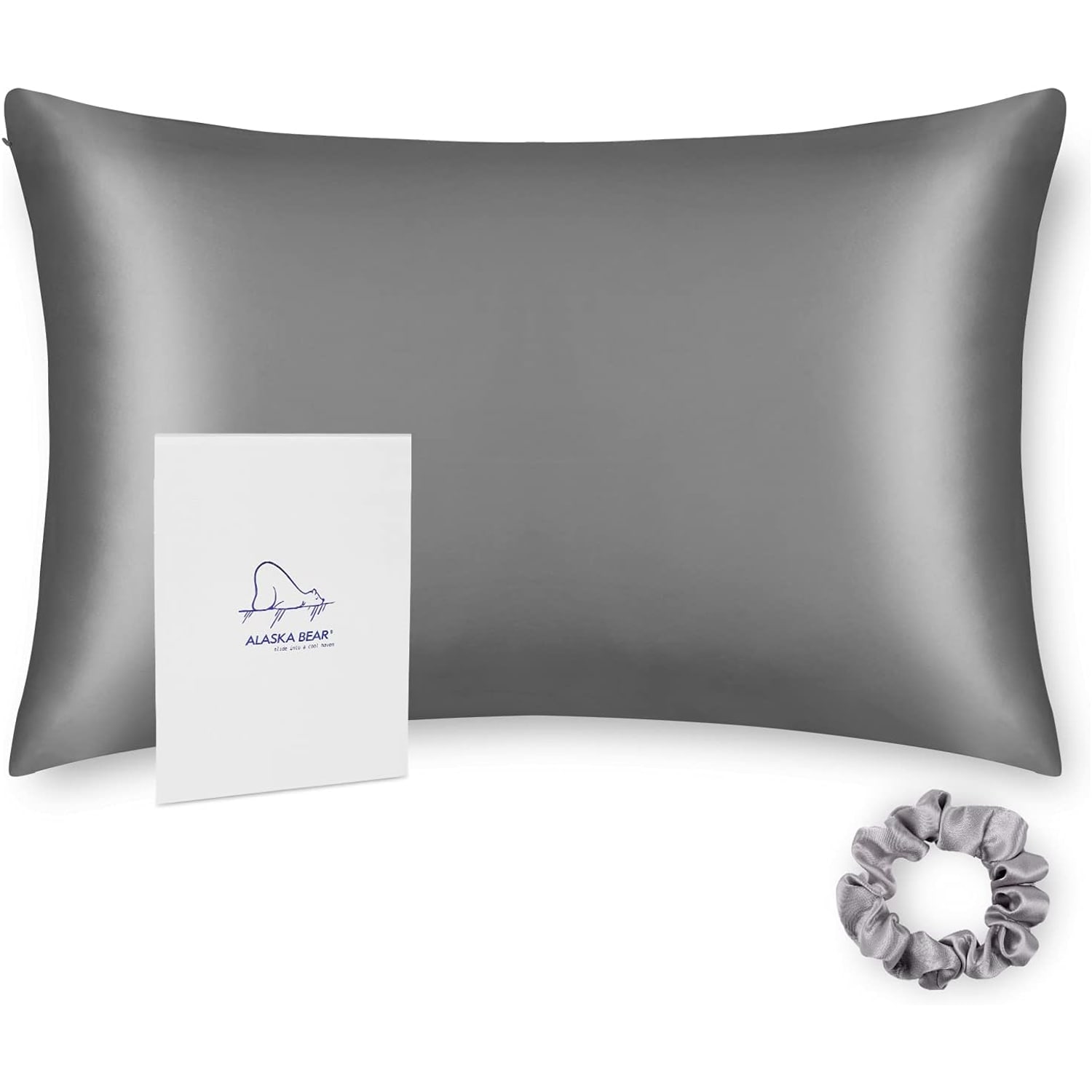
It also suits people buying a present. A solid dark grey is a safe bet for a bedroom you have not seen, and the included silk scrunchie makes the pack feel considered without any wrapping effort on your part.
Who it suits less: anyone who wants to boil-wash their bedding, anyone who owns an oversized or square pillow, and anyone who genuinely will not remember to use a gentle cycle. Silk is not difficult, but it does ask for a slightly different routine.
Looking after it
The care rules are simple and they are not negotiable if you want the case to last.
Wash cool, by hand or on a cold delicate machine cycle with the case inside a mesh laundry bag. Zip it closed first so the zip does not snag the fabric. Use a detergent made for delicates. Avoid bleach, avoid fabric softener, and avoid biological powders, because the enzymes in them are designed to break down protein, and silk is a protein fibre.
Do not wring it out. Press the water out between your hands or roll it in a towel. Dry flat or hang in the shade, well away from radiators and direct sunlight. Skip the tumble dryer altogether.
If it needs pressing, use the lowest silk setting on the reverse side while the fabric is still slightly damp. Keep the iron moving. Most of the time a quick smooth with your hand as you put it on the pillow is enough.
On the first wash, treat it like any dark fabric and wash it separately or with similar colours. Deep dyes can release a little colour early on.
How many to buy
One case covers one pillow. If you sleep on two, you need two. If you want one on the bed while the other is in the wash, you need two per pillow, which is four for a two-pillow sleeper.
A sensible approach is to buy one, use it for a couple of weeks, and see whether you actually notice the difference. Plenty of people do and come back for the rest. Some decide cotton suits them fine, and that is a perfectly reasonable answer too.
The short version
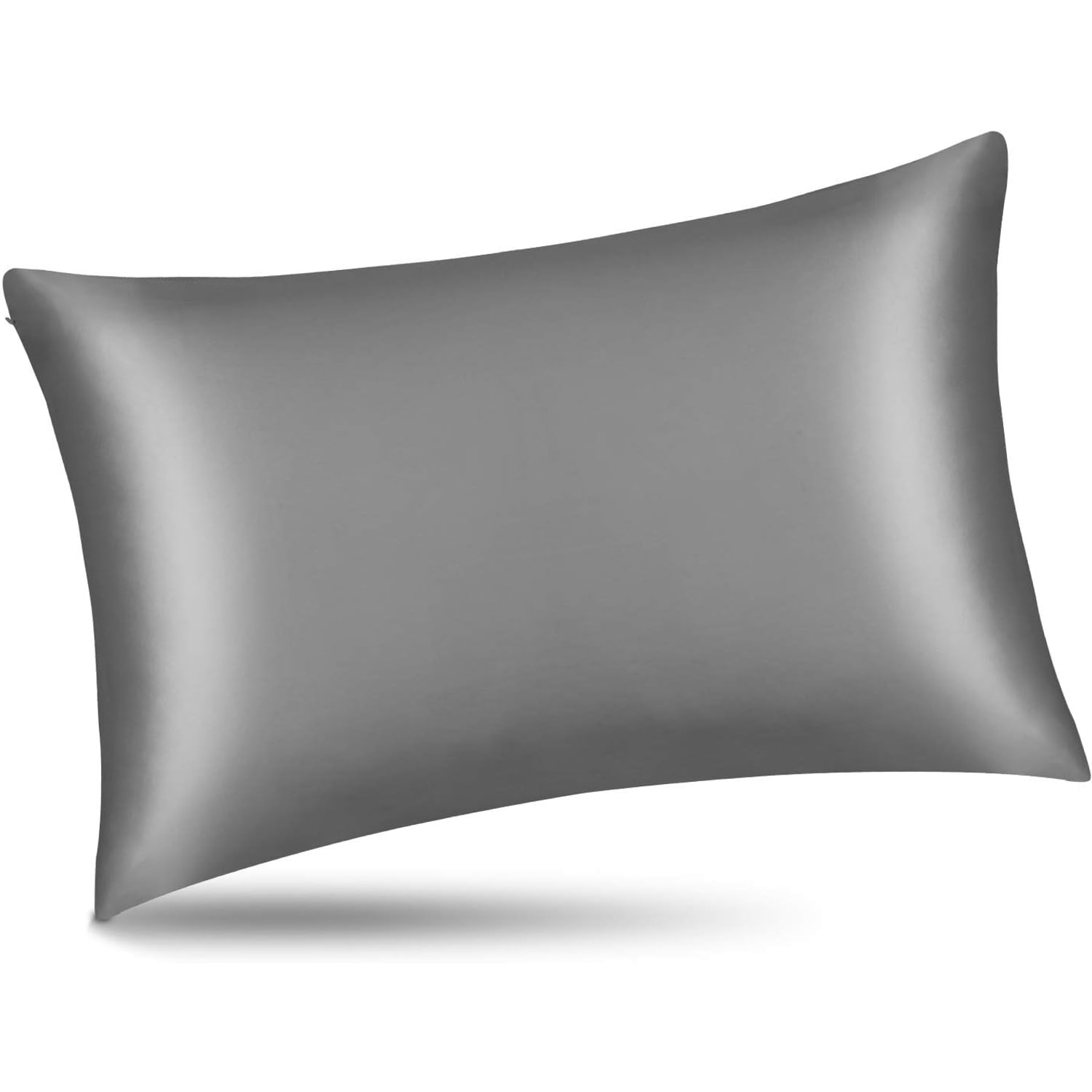
This is a 50 x 75 cm pillowcase in solid iron grey, made from 100% mulberry silk on both sides, woven at 19 momme, with a hidden zip and finished inside edges. A silk scrunchie comes with it.
Nineteen momme is the sensible middle weight. Silk on both sides means you can flip the pillow. The zip stops the pillow escaping. Measure your pillow before ordering, wash it cool, and keep it away from the tumble dryer.
Delivery is tracked from UK warehouses in 3 to 7 working days, and you have 14 days from delivery to cancel under the Consumer Contracts Regulations if it turns out not to be what you wanted.