
The complete guide
How to Choose a Mulberry Silk Pillowcase, A Plain-English Buyer's Guide
The problem a silk pillowcase actually solves
Think about what happens to your head for seven or eight hours every night. It presses into a pillow, turns, presses again, and drags a little each time. If that pillow is covered in cotton, the fabric is doing some gripping. Cotton fibres are short and the weave has texture. Hair catches on it. Skin folds against it and holds the fold.
That is why people wake up with a sleep crease across one cheek, or spend five minutes working a knot out of the back of their hair. Nothing dramatic, just a small daily annoyance.
Silk changes the surface. The filament is long, continuous and naturally smooth, so there is far less for hair and skin to grab onto. You move, the fabric lets you move. That is the entire mechanism, and it is worth understanding clearly because it keeps expectations sensible. A silk pillowcase is a smoother surface. It is not a treatment and it does not do anything to the hair or skin itself.
What the numbers on the label mean
Silk gets described with a few terms that look technical but are simple once you know them.
Momme is the weight measure. It comes from the traditional Japanese system and it tells you how dense the weave is. Lower numbers mean lighter, more translucent fabric. Higher numbers mean more silk per square metre, more body and a heavier drape. Pillowcases are usually sold somewhere between 16 and 25 momme.
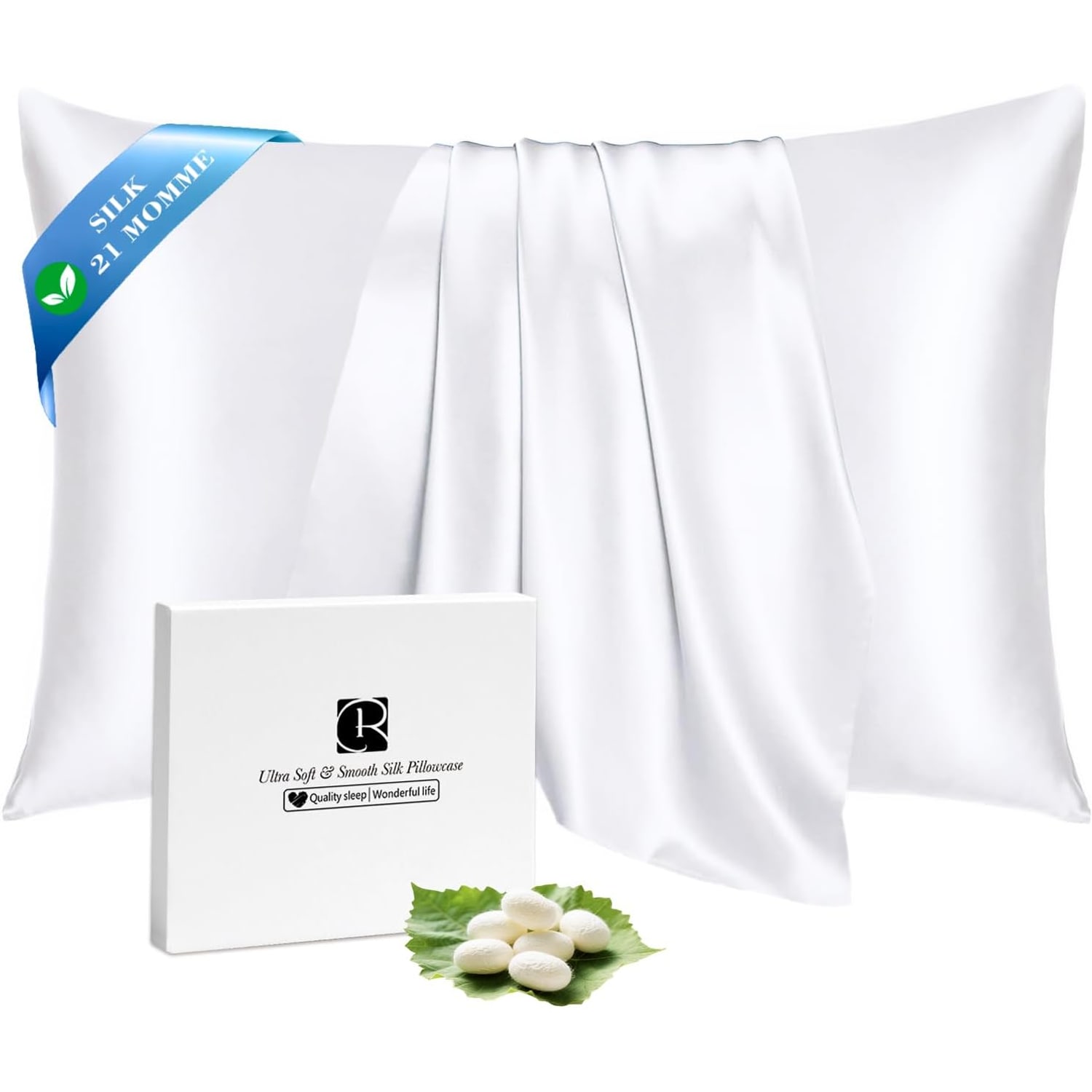
This case is 21 momme. That sits comfortably in the sweet spot. At 16 or 19 momme the fabric is still silk and still smooth, but it can feel thin on the pillow and you sometimes see the pillow colour through it. Go much past 22 and the price starts climbing faster than the benefit. Twenty-one momme has enough weight to lie properly on a pillow without feeling heavy.
Grade refers to the quality of the raw silk. The grading scale tops out at 6A, which is what this fabric uses. It relates to how long, even and strong the filaments are. A higher grade gives a more uniform surface with fewer irregularities in the weave.
Mulberry silk describes the source. Silkworms fed exclusively on mulberry leaves produce a longer, more uniform filament than wild varieties. It is the standard material for good silk bedding.
The both-sides question, and why it matters
Here is the thing a lot of people only discover after they have bought. Many silk pillowcases are not silk all the way through. The sleeping face is silk, and the back is cotton or polyester. It brings the price down and it is not dishonest, as long as the listing says so.
This one is silk on both faces. Front and back, 100% mulberry silk.
Why does that matter in practice? Three reasons. You can flip the case over without losing the feel, which is useful mid-week when the top surface has picked up a bit of hair product. The fabric drapes evenly, instead of having a stiff side and a fluid side. And the two faces shrink and wash at the same rate, so the seams do not pucker after a few cycles the way mixed-fabric cases sometimes do.
If you are comparing options, the back of the case is the first thing worth checking. Anyone hunting for the best both sides silk pillowcase is really just avoiding that mismatch.
Getting the size right
This case measures 50 x 75 cm, written as 20 x 30 inches. That is the UK standard, and it is what most pillows sold in Britain are built to.
But do measure. A few situations throw people off:
Older pillows that have been plumped and re-plumped for years can be slightly oversized. Continental pillows are square and much larger. Some imported pillows, especially American ones, follow a different standard. And king-size pillows are noticeably longer.
Lay the pillow flat on the bed and run a tape measure across the long edge and the short edge. If you land at or just under 50 x 75 cm, you are fine. If the pillow is bigger, the silk will be stretched tight over it, which puts strain on the seams and loses the soft drape that you paid for in the first place. If it is much smaller, the case will sit loose and shift around overnight.
Zip or envelope flap
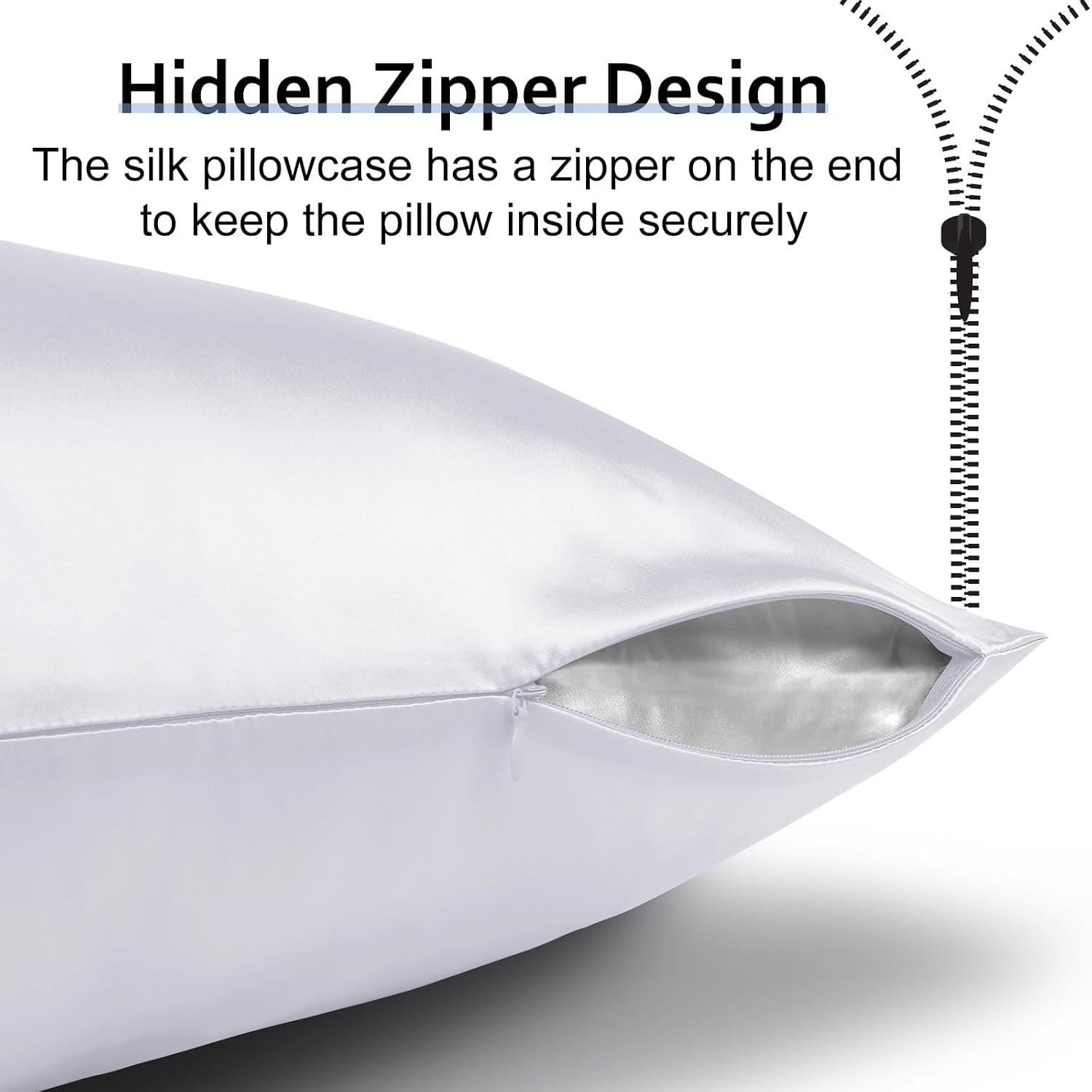
The closure on this case is a hidden zip at the end. The alternative design is an envelope flap, where the fabric folds back over itself.
Zips keep the pillow fully enclosed. Nothing works its way out at three in the morning, and the edge of the bed looks neat and finished. The trade-off is that you need to be slightly careful in the wash, so close the zip before it goes in the machine and use a mesh bag so the metal cannot rub against the silk.
Envelope flaps are quicker to change and have nothing to snag. They also have a habit of gaping open if the pillow is plump, which some people find untidy.
Neither is wrong. If you toss and turn, the zip is the more reliable option.
Why white is the easy choice
Colour is where people overthink bedding. Pure white solves most of it.
It matches white hotel-style sets exactly. It sits quietly next to patterned duvet covers without competing. It works against a dark headboard and against a pale one. And it does not clash with anything you buy later.
There is a practical side too. With white you can see when the case needs washing, which sounds obvious but is genuinely useful with a fabric you want to keep clean against your face. It is one reason the best white silk pillowcase tends to be the one people reach for first, even when they own coloured ones.
Looking after it
Silk has a reputation for being difficult. It really is not, it just does not like heat and harsh chemicals.
Wash it on a cool, gentle or delicates cycle. Use a mild liquid detergent, nothing with bleach or heavy enzymes, and no optical brighteners. Put the case inside a mesh laundry bag first with the zip closed, which stops it twisting around the drum and protects it from zips and buttons on other items.
Skip fabric softener completely. Silk is already smooth, and softener leaves a film that dulls the natural sheen over time.
For drying, reshape the case while it is damp and hang it or lay it flat, away from direct sun and away from radiators. It dries fast. Avoid a hot tumble dryer, because heat does more damage to silk than washing ever will.
If it needs pressing, use a low iron on the reverse while the fabric is still slightly damp. A pressing cloth helps if your iron runs hot.
Wash roughly once a week. More often if you use rich night creams or leave-in hair products, since those transfer onto the fabric.
Who this suits
People with long hair, because long hair catches on cotton more than short hair does. People with fine hair, for the same reason. Anyone who wakes up with pillow creases on their face. Anyone who sleeps hot and likes the cool first touch that silk gives. And people who just want their bed to feel a bit nicer, which is a perfectly good reason on its own.
It also makes a dependable gift. A plain white silk case works in almost any bedroom, so you do not need to know someone's colour scheme to get it right.
Buying two
Worth mentioning, since the listing is for a single case. If you want silk on the bed all the time, two cases means one is always on the pillow while the other dries. If you share a double bed, two gives you a matching pair.
Plenty of people start with one to see how they get on with silk, then order a second. That is a reasonable way to do it.
The short version
This is a 100% mulberry silk pillowcase, grade 6A, woven to 21 momme, silk on both sides. It is cut to the UK standard 50 x 75 cm (20 x 30 inches), finished in pure white, and closes with a hidden zip. It is machine washable on a cool, gentle cycle.
The weight is right for bedding. The both-sides construction means no cotton backing. The size fits most British pillows, though you should measure yours first. Care is simple as long as you keep it away from heat and softener.
Delivery is tracked from UK warehouses in 3 to 7 working days, and you have 14 days from delivery to cancel for any reason under the Consumer Contracts Regulations.