
The complete guide
Silk Pillowcase Buyer's Guide, 21 Momme and Why Size Matters
The problem with waking up creased
Most of us never think about the pillowcase. It is the last bit of bedding anyone shops for, usually bought in a set, usually cotton, usually ignored until it wears thin. Then one morning you catch yourself in the mirror with sleep lines across one cheek and hair that looks like it lost an argument with the pillow.
That is friction. Cotton, even good cotton, has a slightly dry, grippy surface. When you turn over at night, your skin and hair do not glide across it. They catch, pull a little, and settle somewhere else. Over seven or eight hours and a dozen turns, that adds up.
Silk behaves differently. The fibre is smooth and the weave is tight, so things slide. That is the whole pitch, really. A silk pillowcase does not do anything clever, it just has a surface that your face and hair move over instead of dragging against. Whether that is worth the price depends on how much the difference matters to you, and the honest answer is that most people who try one do not go back.
What momme actually tells you
Silk is sold by momme, which trips people up because nothing else in bedding uses it. Cotton uses thread count. Linen uses GSM. Silk uses momme, usually written as mm, and it measures how much silk is packed into a set area of cloth.
Silk bedding generally runs from about 16 momme at the light end to 25 at the heavy end. Below 16 you are into scarf territory, where the fabric is lovely to handle but too fine to take a weekly wash on a bed. Above 25 the cloth gets stiff and the price climbs steeply, and you stop noticing the extra weight.
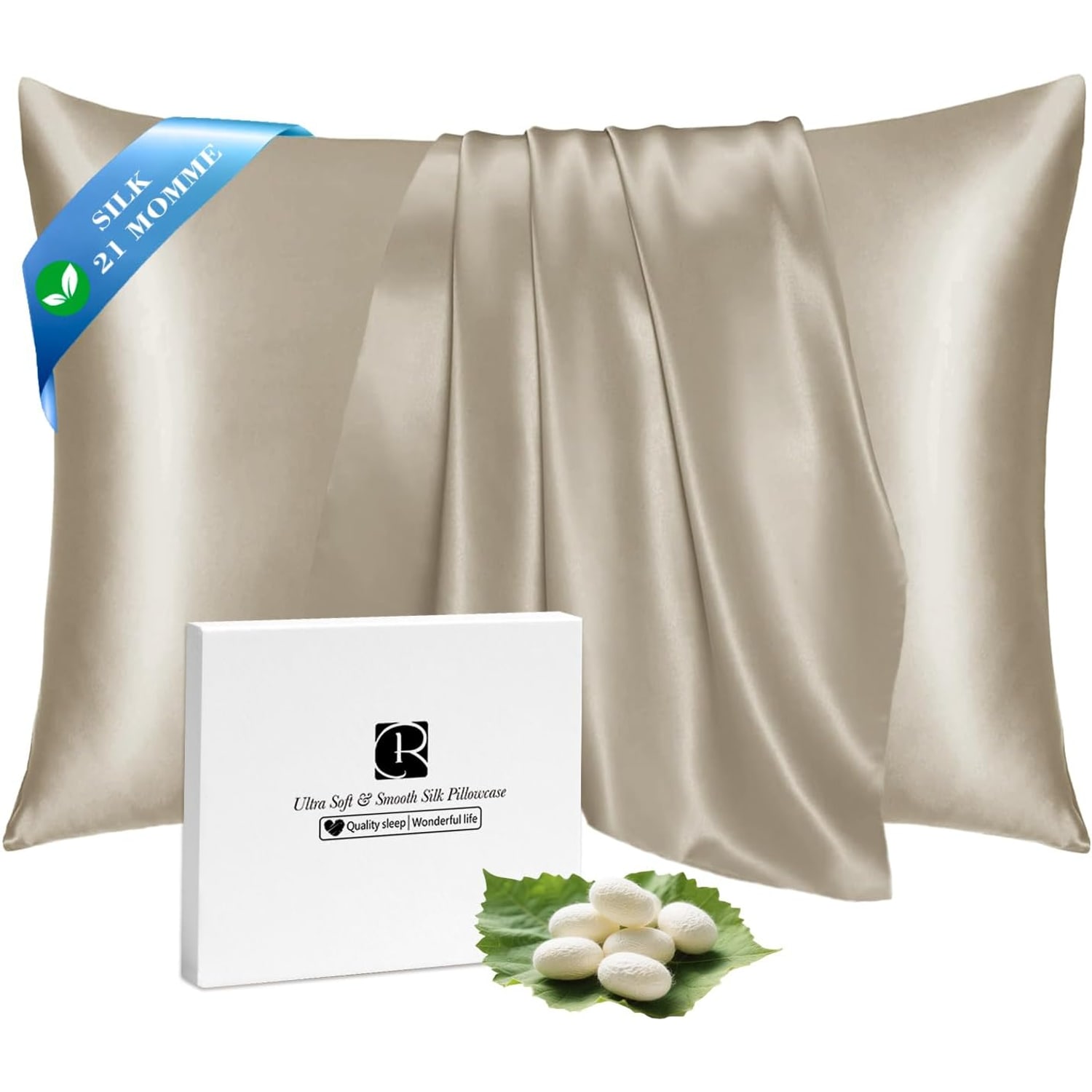
This case is 21 momme, which sits in the heavier half of the normal range. In practice that means a few things. It feels substantial when you pick it up, with real drape rather than that floaty quality of thin silk. It holds its shape over the pillow instead of clinging. And it copes better with repeated laundering, because there is simply more fibre there to wear down. If you are comparing the best 21 momme silk pillowcase options against cheaper 16 momme ones, that durability is where the gap shows up after six months.
Silk on both sides, and why it is worth checking
Here is something that catches people out. A lot of silk pillowcases are silk on the sleeping face only, with a cotton or polyester backing. The listing says silk, the label says silk, and technically it is not wrong. But you have a pillowcase that only works one way up, and if you flip the pillow in the night you are back on ordinary fabric.
This one is 100% mulberry silk on both sides. Both faces are the same. Flip the pillow, turn the case inside out by accident when you are making the bed, it makes no difference. For anyone who moves their pillow around, the best double sided silk pillowcase is simply the one you do not have to think about.
Mulberry silk, by the way, refers to the source. Silkworms fed exclusively on mulberry leaves produce longer, more even filaments than wild-fed worms, which is why mulberry silk is the standard for bedding. The grade 6A marking on this case refers to the thread quality, with 6A at the top of the common grading scale.
Getting the size right
This is the single most common mistake in silk pillowcase buying, and it is easy to avoid.
The case measures 50 x 75 cm, which is 20 x 30 inches. That is the standard UK pillowcase size, and it fits a standard UK pillow. Most pillows sold in British shops as standard will go in comfortably.
Problems start when your pillow is not standard. King size pillows are longer, typically around 50 x 90 cm. Continental pillows are square, usually 65 x 65 cm. Some memory foam and orthopaedic pillows are deeper or oddly shaped. Any of those and a standard case will either not fit or will stretch awkwardly over the corners.
So before you order, strip the case off your pillow, lay it flat on the bed and measure it. Width and length. If you land near 50 x 75 cm you are fine. If you are reading something else, you need a different size, and no amount of hoping will change that.
One more thing. This is a single pillowcase. If you want a pair on a double bed, order two. People regularly order one, love it, and come back for the second a month later.
The zip, and what it is for
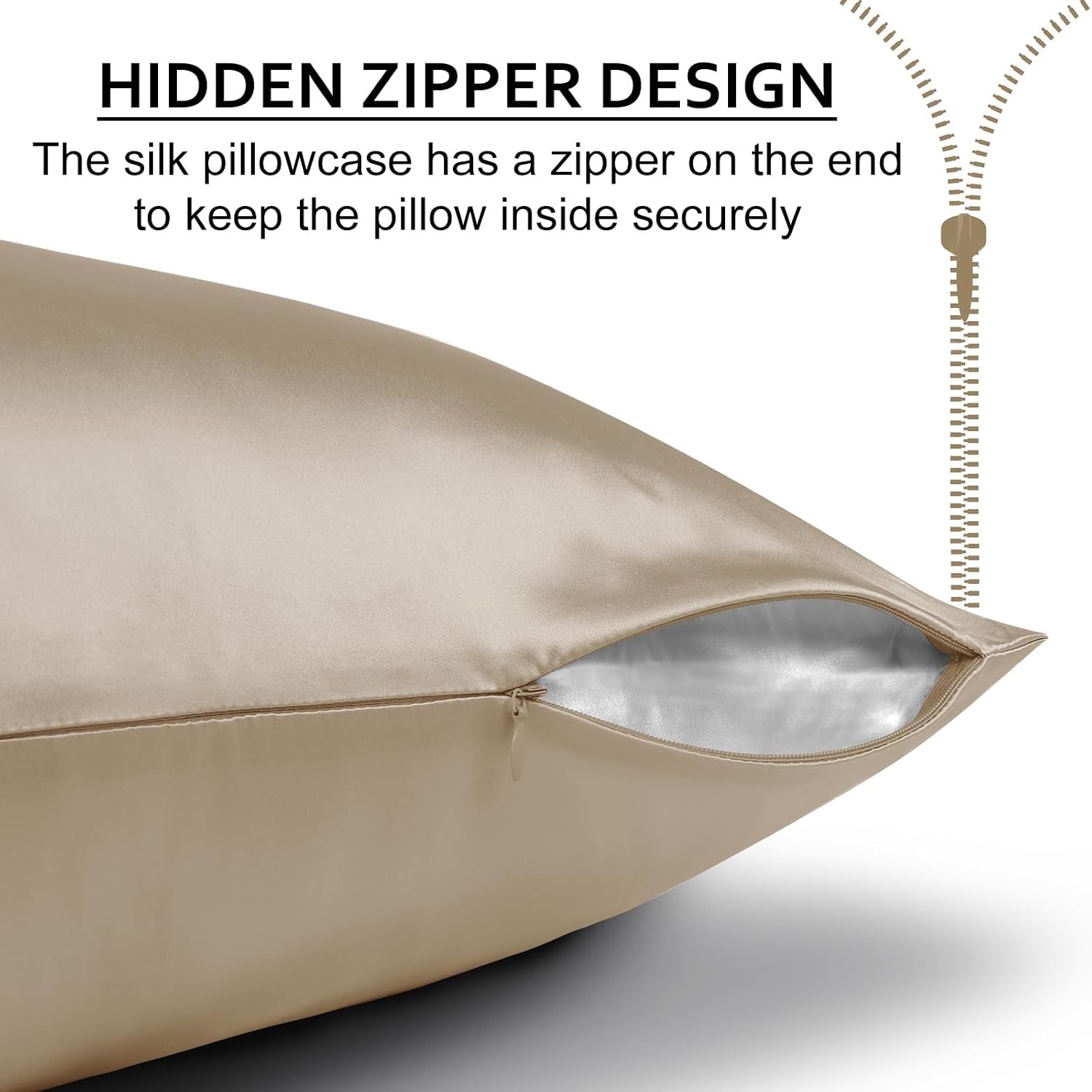
The closure is a hidden zip at the end of the case. The pillow goes in, the zip closes, and the hardware tucks away so you neither see it nor feel it while you sleep.
The alternative is an envelope flap, where a fold of fabric tucks over the open end. Envelope closures have no hardware at all, which some people prefer. The trade-off is that pillows can work their way out of an envelope case if you are a restless sleeper, especially with silk, which is slippery by nature. A zip holds everything in place.
Practical tip for laundry day, close the zip before washing. An open zip pull can catch on the silk during a wash cycle, and that is the one way a zip can cause trouble.
Why taupe
Colour choice in silk is more consequential than in cotton, because silk reflects light. A bright colour reads brighter in silk than it would in a matte fabric, and pure white silk can show faint sheen variations after washing.
Taupe sidesteps both issues. It is a warm neutral sitting between grey and beige, muted enough to be quiet in the room but with enough warmth to avoid looking cold. It sits happily with white sheets, oatmeal linen, charcoal throws, brass lamps, wooden headboards. It is not a colour that dates, and it does not demand that the rest of your bedding match it.
If you are buying as a gift, that matters. A neutral silk pillowcase is a safe present in a way that a jewel-toned one is not.
Looking after it
Silk has a reputation for being delicate that is only half earned. This case is machine washable, and the routine is not complicated.
Wash on a cool, gentle or delicates cycle. Put the case inside a mesh laundry bag first, which protects it from zips and buttons on other items in the drum. Use a mild detergent intended for delicates. Skip the fabric softener, which coats fibres and dulls the finish, and skip biological detergents with enzymes, which are designed to break down protein and silk is a protein fibre.
Wash it away from towels, denim and anything with hooks. Line dry out of direct sunlight and away from radiators. It dries quickly.
If you want the crisp look back, press with the iron on its lowest setting while the silk is still slightly damp. Plenty of people skip this because 21 momme silk has enough weight to hang smooth on its own.
Two cases make rotation easy, so one is on the bed while the other is in the wash. Most people wash a pillowcase weekly or fortnightly, and that suits silk fine.
Who it suits, and who it does not
It suits anyone who wakes up with creases and tangles and has decided to do something about it. It suits people with long or fine hair, who tend to notice the reduced friction most. It suits anyone who likes the cool feel of silk against the face in warm weather. And it suits gift buyers, because it reads as a treat without being a gamble.
It does not suit you if your pillow is not a standard UK size, which is worth repeating. It does not suit anyone who wants a wash-and-forget fabric, because while silk is easy enough, it does ask for a cool cycle rather than being thrown in with the towels. And if you only ever buy bedding in sets, a single case in a different fabric may feel odd.
The short version
This is a single taupe pillowcase, 100% mulberry silk on both sides, grade 6A, woven at 21 momme, sized 50 x 75 cm (20 x 30 inches) with a hidden zip, machine washable.
The 21 momme weight means it feels dense rather than thin and should hold up to regular washing. Silk on both faces means you never have to check which way the pillow goes. The standard UK sizing fits most British pillows, but measure yours first because that is where orders go wrong.
Delivery is tracked from UK warehouses in 3 to 7 working days, and you have 14 days from delivery to cancel for any reason under the Consumer Contracts Regulations. If it turns out not to be right, tell us and we will sort it.