
The complete guide
Buying a Silk Pillowcase Set of 2, A Practical Guide
The problem with waking up creased
Most people do not think about what their face spends eight hours pressed against. Then one morning you catch yourself in the bathroom mirror with a diagonal line running across one cheek, and your hair looks like it has been through a hedge on one side only. That is friction. A standard cotton pillowcase is a woven fabric made from short staple fibres, and on a microscopic level the surface is full of tiny catches and loops. Skin bunches against it. Hair drags.
Silk behaves differently because it is a continuous filament rather than a spun staple. The surface is smooth and the fibres lie flat, so your cheek slides across it instead of gripping. You notice this the first night, usually when you turn over and the pillow does not pull at your hair. It is a small change to the bed, and it is one of the few bedding upgrades where the difference is obvious immediately rather than three weeks later.
What 19 momme actually tells you
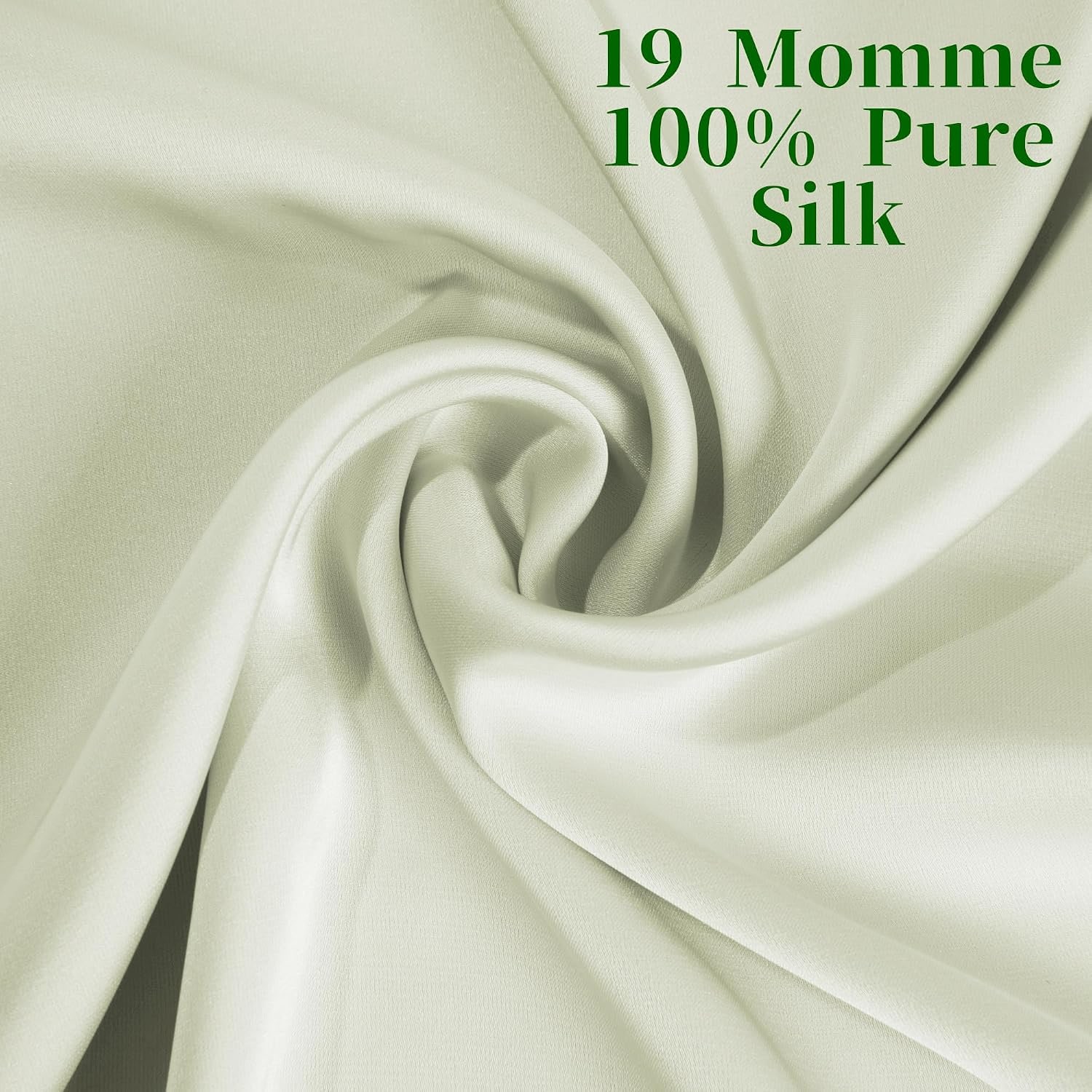
Silk is measured in momme, written mm but pronounced "mommy". It is a weight measure. Specifically, it is the weight in pounds of a piece of silk 45 inches wide and 100 yards long. A higher momme means more silk per square inch, which means a denser, heavier fabric.
For pillowcases, the useful range runs from about 16 to 25. Below 16 the fabric starts to feel thin and almost translucent, and it does not drape well over a pillow. Above 22 it gets quite heavy and the price climbs sharply. Nineteen momme sits in the middle and is where most of the market has landed, for good reason. It has enough weight to hang properly and feel substantial when you pick it up, it holds a hidden zip without the seam pulling, and it does not price itself out of ordinary use.
These cases are 19 momme on both sides. That last part is worth pausing on. A lot of silk pillowcases are what the trade calls single-sided, meaning silk on the face and a cheaper cotton or polyester backing. You only ever sleep on one side of those, which halves the benefit and makes washing trickier because two different fibres shrink at different rates. Here, front and back are the same grade 6A mulberry silk, so you can flip the case over whenever you like.
Grade 6A, and what grading means
You will see grade 6A on most good mulberry silk. The grading system scores raw silk filament on things like length, evenness and cleanliness, with 6A at the top of the usual commercial scale. It is a description of the raw material going into the weave, not a performance promise. A 6A grading tells you the filament is long and consistent, which is why the finished fabric feels even rather than slubby.
Mulberry silk itself refers to silk from silkworms fed exclusively on mulberry leaves. The diet produces a longer, finer, more uniform filament than wild silk varieties, which is why it is the standard for bedding. When you are comparing options and looking for the best mulberry silk pillowcase, those two terms together, mulberry and 6A, are the baseline to expect.
Getting the size right
This is where most silk pillowcase orders go wrong, so read this bit carefully. These are listed as standard size, and the maker does not publish the measurements in centimetres. That is not unusual with imported silk bedding, but it does mean the job of checking falls to you.
A standard UK pillowcase is 50 x 75 cm (20 x 30 in). A king size UK pillowcase is 50 x 90 cm (20 x 36 in). That 15 cm difference is enough that a standard case simply will not go on a king pillow properly, and if you force it the seams take the strain.
So before you order, pull a cotton pillowcase off your bed and measure it flat. If it comes out around 50 x 75 cm, you are in standard territory and these will fit. If it is longer, look for a king instead. If your pillow is a contoured memory foam shape or a very deep hotel-style pillow, a flat standard case may fit tightly even at the right nominal size, because the depth eats into the length.
The hidden zip, and why closure type matters
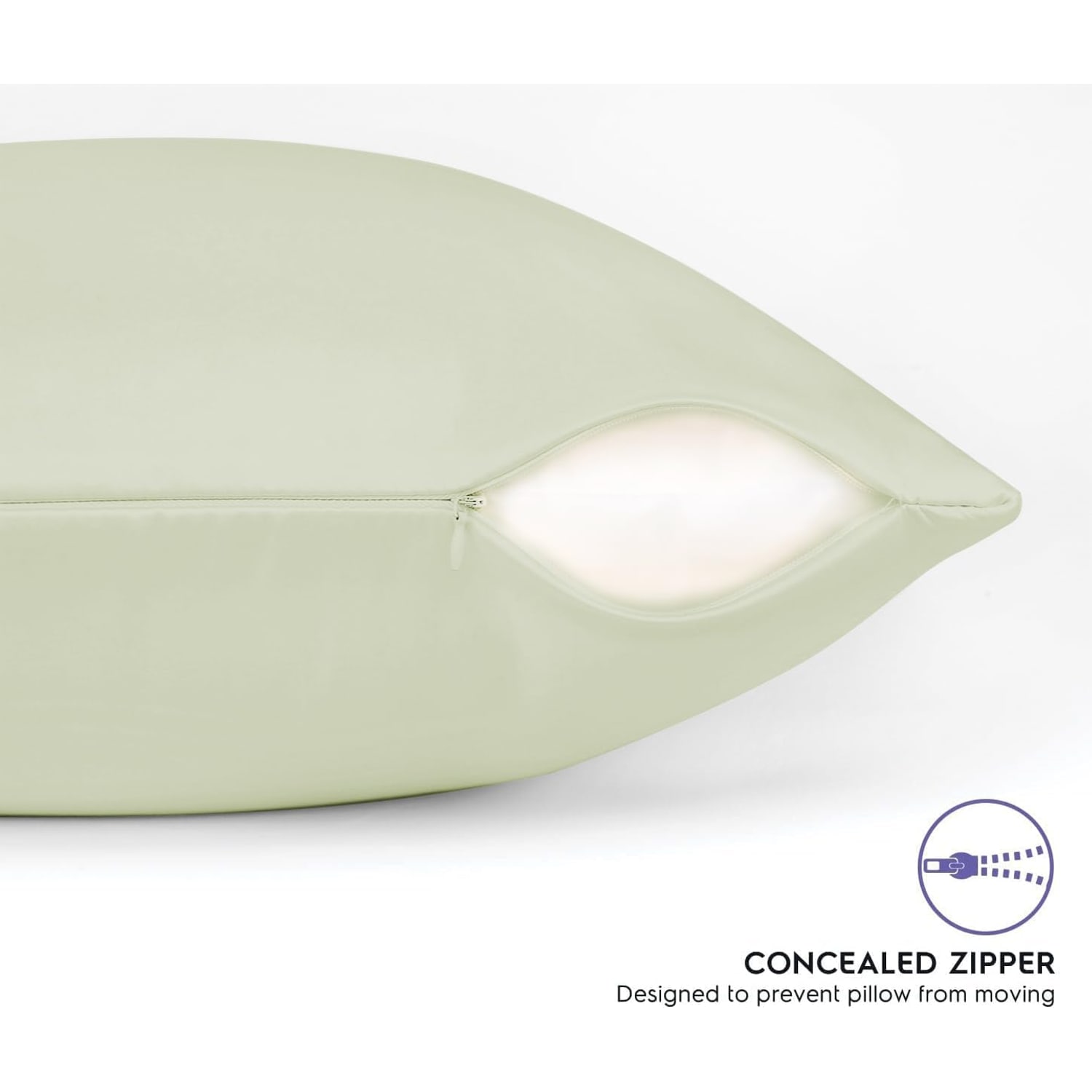
Pillowcases close in one of three ways. An envelope flap tucks the pillow in behind a fold of fabric. A housewife style has an open end with an internal flap. A zip runs along one edge and shuts properly.
A zip has two clear advantages on silk. First, the pillow stays put. Silk is slippery by nature, and a plump pillow in an envelope case will work itself halfway out by morning, leaving you sleeping on a bare corner. Second, with the zip concealed under a fold, there is nothing hard sitting in the sleeping area. You do not feel it.
The trade-off is that a zip needs a bit of care. Open and close it slowly, hold the fabric clear of the teeth, and do up the zip before washing so it cannot catch on the silk. Do that and it will outlast the case.
Colour, and living with sage green
Sage is a soft, slightly greyed green. It is not a statement colour and it does not try to be. On silk the shade shifts a little as light moves across the fabric, which gives it more depth than the same colour printed on cotton would have.
Practically, it gets on well with white, off-white, warm grey and natural linen. It also sits comfortably against pale wood and most neutral wall colours. If your bedroom is already full of pattern, a plain case is a relief. If everything is white, sage green silk bedding adds just enough colour to stop the bed looking like a hospital.
Looking after them
Care is hand wash only. That sounds like more work than it is.
Fill a basin with cool water and add a small amount of detergent made for silk or wool. Swish the case through for a minute or two, concentrating on where your face and hair sit. Do not soak it, do not scrub it, and do not use anything with bleach or enzymes. Rinse in clean cool water until the water runs clear.
Then the drying. Never wring silk. Press the water out between your flat palms, lay the case on a dry towel, roll the towel up like a Swiss roll and press. Unroll, and hang the case up or lay it flat, out of direct sun. Sunlight fades dye and weakens the fibre over time.
If you want it crisp, iron on the lowest silk setting while it is still slightly damp, working on the reverse. Most people skip this because silk drops smooth on its own.
Having two cases makes the whole routine easier. One goes on the bed, one stays in the drawer, and you swap rather than scrambling. Washing weekly is a sensible habit, more often if you use night creams or hair products.
Who this suits
If you sleep on your side or your front, you get the most out of it, because that is when your face and hair spend the longest in contact with the pillow. If you have long hair, the reduced drag is immediately noticeable. If you run warm at night, silk feels cool when you first lie down.
If you are someone who wants everything to go in the machine on a Sunday, hand washing will nag at you. Be honest with yourself about that before ordering.
The short version
Two standard-size pillowcases, 100% mulberry silk at 19 momme on both faces, grade 6A, sage green, hidden zip, hand wash only. The weight is the practical sweet spot for bedding. Double-sided silk means you get the benefit whichever way up the case lands. The zip keeps the pillow where it should be.
Measure your pillow first. If it is around 50 x 75 cm, you are sorted. Delivery is tracked from UK warehouses in 3 to 7 working days, and you have 14 days from delivery to change your mind under the Consumer Contracts Regulations.