
The complete guide
Choosing a Long Silk Bonnet for Long, Thick or Curly Hair
The problem with most sleep bonnets
Here is the scene. You have spent half an hour drying and styling your hair. You put on a bonnet, go to bed, and in the morning half of it has escaped and the half that stayed in has a fold pressed into it. The cap was not faulty. It was just too small for the amount of hair you asked it to hold.
Most bonnets on the market are round and shallow, built on the assumption that hair can be gathered into a tidy bun on top of the head. That works fine if your hair sits at chin or shoulder length. It stops working when hair reaches the middle of your back, or when it is thick enough that a bun is the size of a grapefruit, or when it is in braids or locs that simply do not fold.
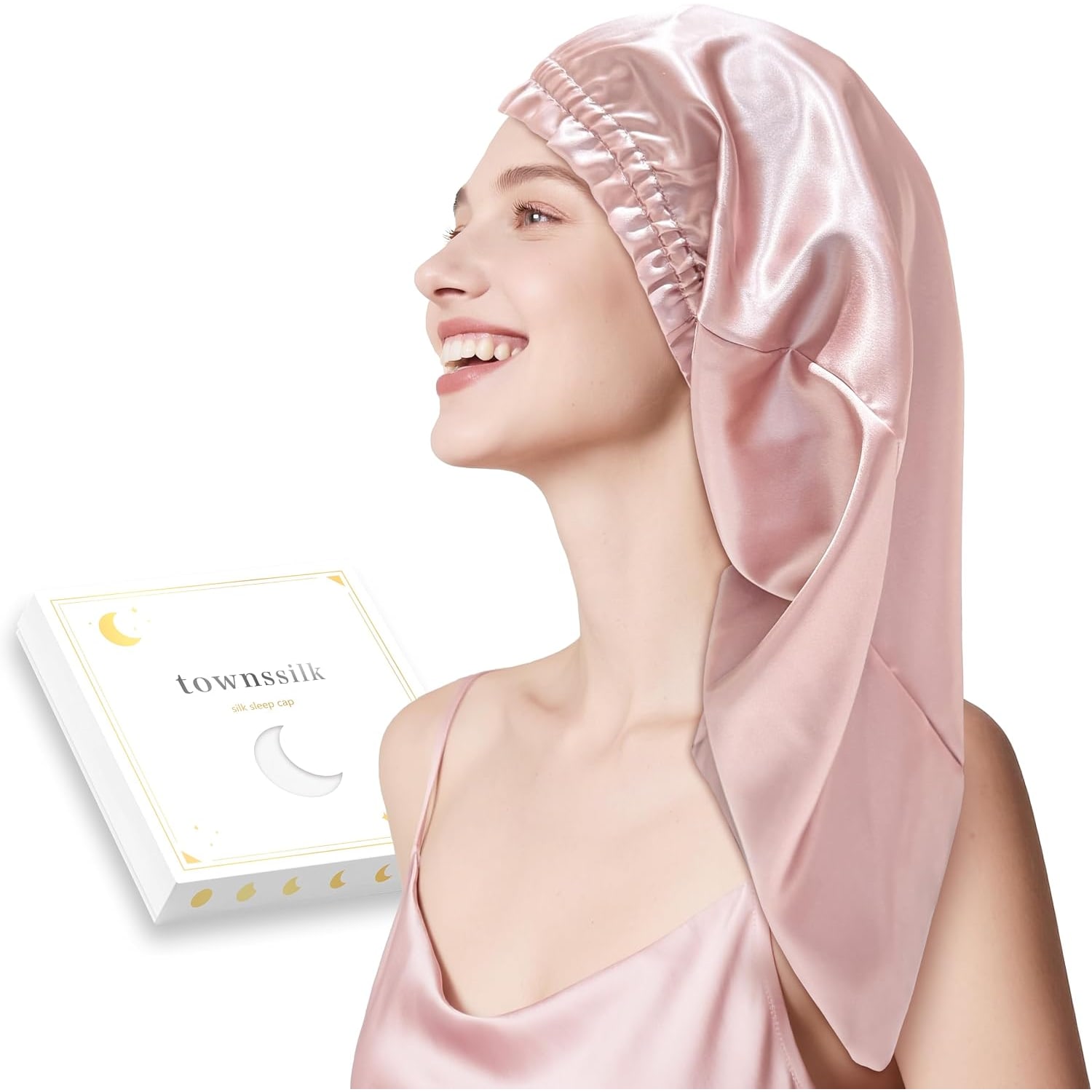
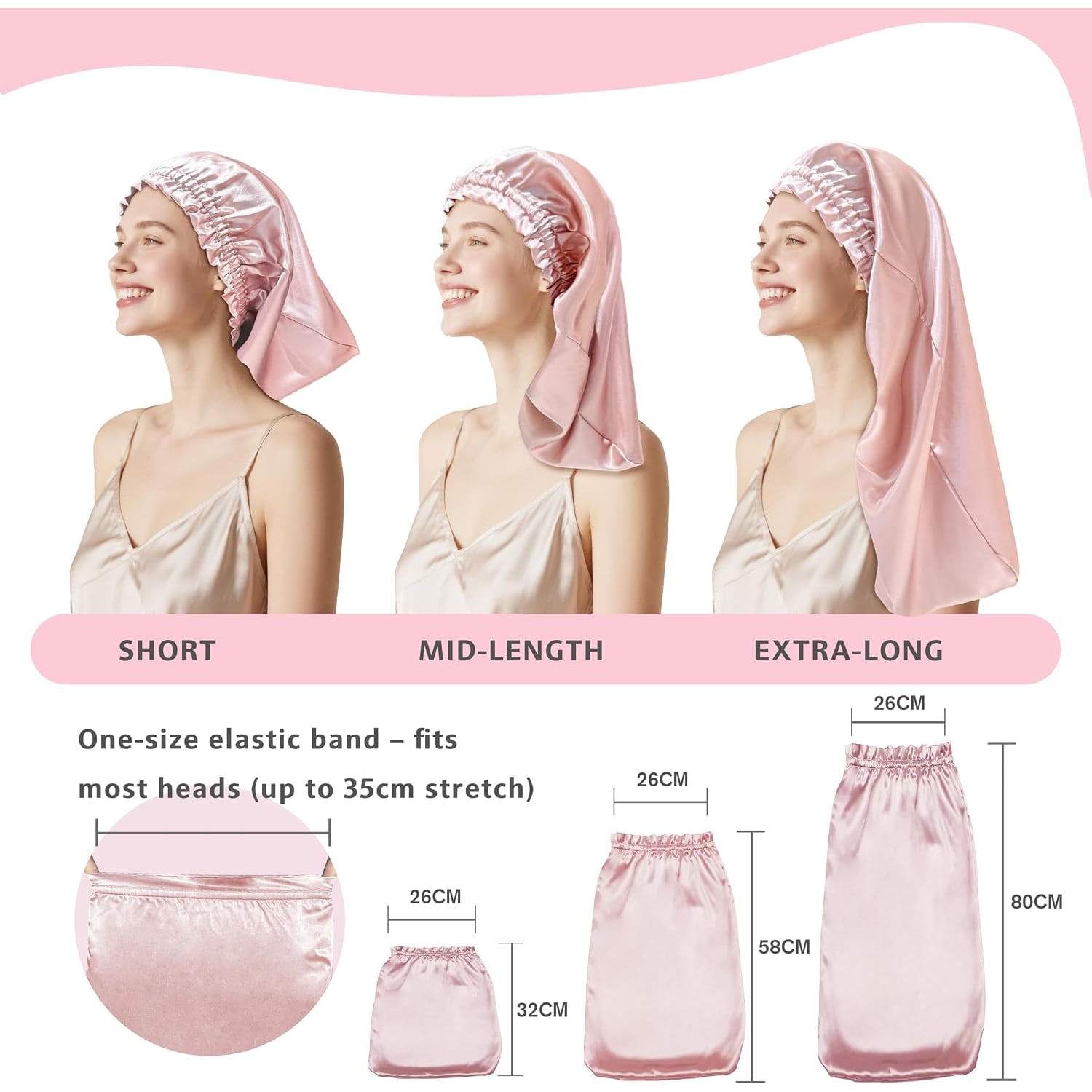
A long bonnet takes a different approach. Instead of asking the hair to compress, it gives it somewhere to lie down. This one is 80 cm (31.5 in) from end to end, which is enough for most waist-length hair to sit inside without being coiled under tension. You notice the difference in the morning, when there is no crease line across the length and no handful of hair fallen out of the opening.
What 22 momme actually tells you
Silk is sold by momme, which is a weight measure. The higher the number, the more silk there is in the same area of fabric. Light dress silks sit in the low teens. Twenty-two momme is in the heavier everyday range used for pillowcases and sleepwear that people expect to keep for years.
What does that feel like? A 22 momme silk has body. It drapes rather than floats. When you pull it on, it settles against your head instead of lifting off with every movement. It is also less see-through and less prone to snagging than a thin silk, simply because there is more fibre packed into the weave.
Mulberry silk is the type, not the weight. It comes from silkworms raised on mulberry leaves, and the fibres are long and uniform, which is why the surface comes out so smooth. Put the two together, mulberry silk at 22 momme, and you have the specification most people have in mind when they go looking for the best mulberry silk bonnet rather than a generic satin one.
Silk versus satin, and why it matters
This trips a lot of people up. Satin is a weave, not a fibre. You can weave satin out of polyester, and most inexpensive bonnets are exactly that. Polyester satin is shiny and slippery, which is why it looks similar in photographs.
The difference shows up in use. Polyester does not breathe in the same way, so it can feel warm against the scalp through a whole night. It also tends to build a static charge, which is the opposite of what you want around fine hair. Silk is a natural protein fibre, it breathes, and it has weight to it.
None of that means satin bonnets are useless. For a short nap or a travel bag they are fine. But if you are buying one cap to use every night for years, the fibre is worth paying attention to.
Who this length suits
The 80 cm cut is aimed at four groups in particular.
People with hair past the shoulder blades, who find standard bonnets force them to twist hair tighter than is comfortable. People with very thick hair, where volume rather than length is the problem. Anyone wearing braids, twists or locs, where the hair simply cannot be compressed at all. And people with defined curls who want the curl pattern to stay loose overnight rather than being flattened against the skull.
If your hair sits at chin length, this cap will be more fabric than you need. It will still work, you will just have length to spare. In that case a standard round cap is the easier choice and will cost less.
How a pull-on fit works in practice
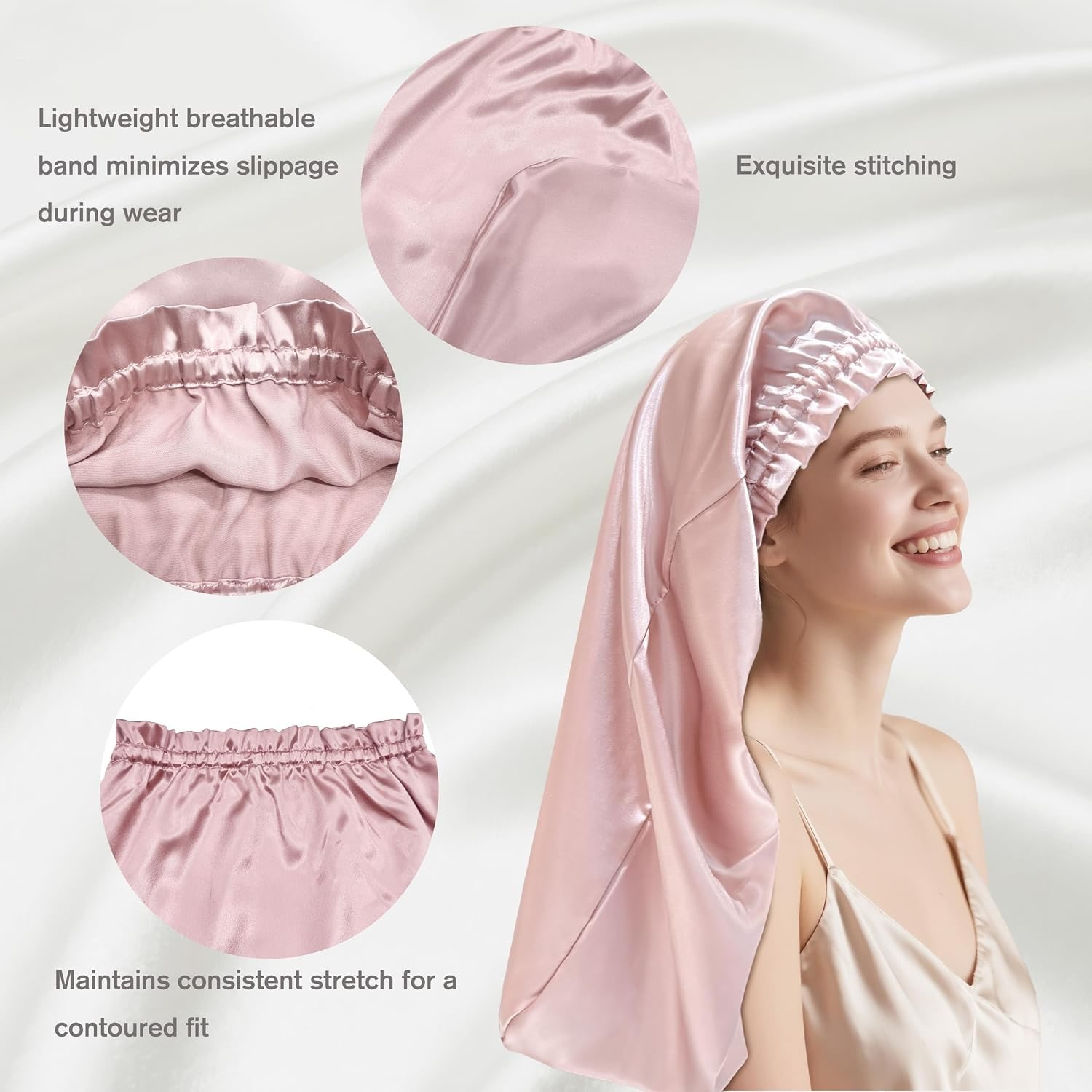
There are three common closures on sleep caps. Ties, drawstrings and pull-on elastic. Ties give the most control but take both hands and a mirror. Drawstrings sit somewhere in the middle and have a habit of loosening as you move.
This one is pull-on. You gather your hair, stretch the opening, pull it over, and you are done. It sounds like a small thing, but it decides whether a bonnet gets used. A cap you can put on in four seconds with your eyes half shut is a cap you will reach for on the nights when you are tired, and those are exactly the nights when hair gets roughed up the most.
If you find the opening sits too loose for your head, tucking the full length of hair inside gives the cap a bit more weight, which helps it settle. If you tend to toss and turn hard, a long bonnet is generally more secure than a short one for that reason.
Getting the hair in properly
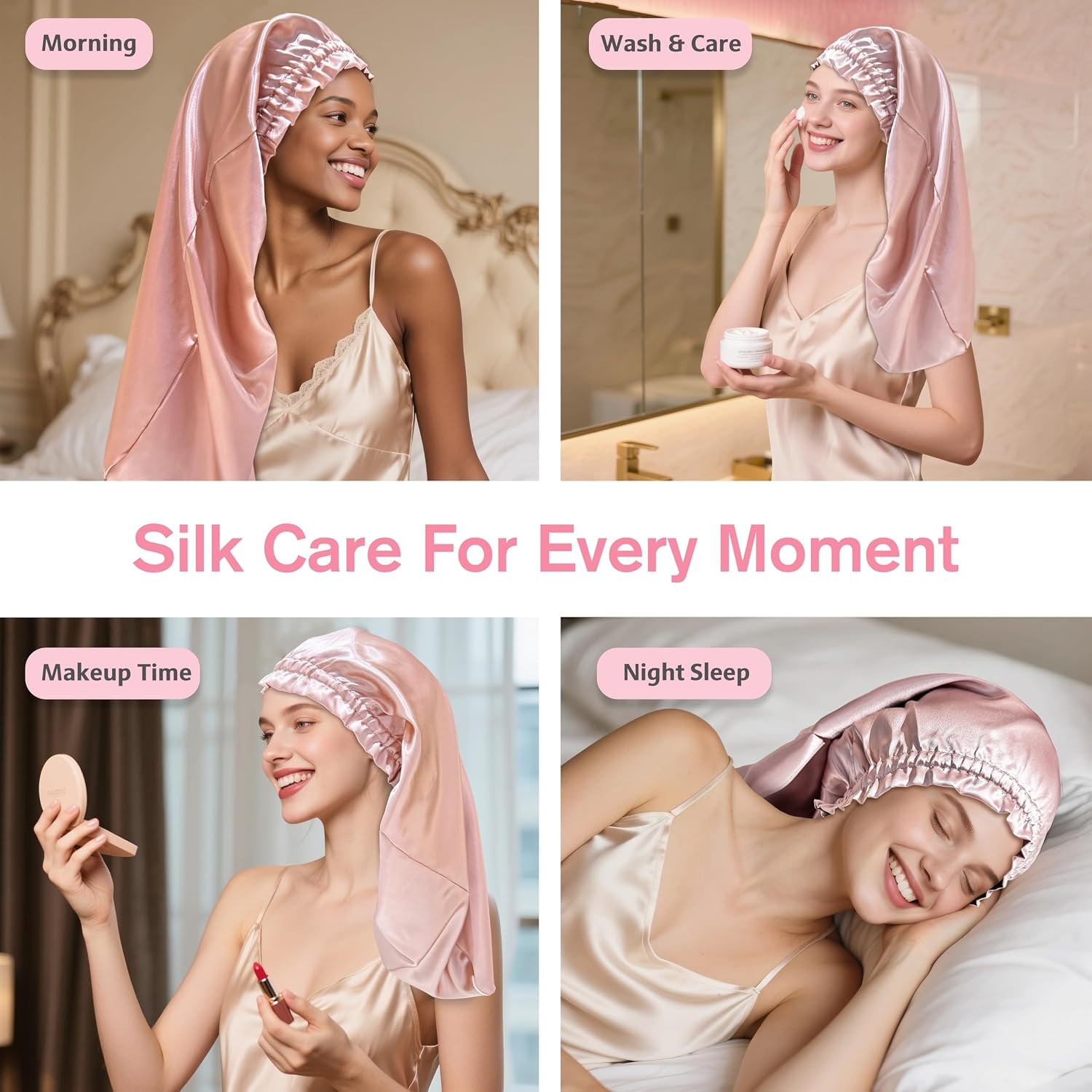
A long bonnet rewards a little technique. Rather than piling hair on top of your head, let it fall back behind you, then slide the cap on from the forehead and guide the length in with your other hand. The hair ends up lying along the inside of the cap instead of bunched at the crown.
For curls, resist the urge to pull everything tight. The whole point of the extra length is that curls can sit loose. For braids or locs, gather the lengths together first so they go in as one bundle rather than catching at the opening one at a time.
If you use leave-in products, let them absorb for a few minutes before putting the bonnet on. Wet product and fine silk are not friends, and washing it out later takes more effort than waiting ten minutes.
Caring for it so it lasts
Hand wash or dry clean. Those are the two options, and both work.
For hand washing, fill a basin with cool water and add a small amount of detergent made for silk or delicates. Swirl the bonnet through the water rather than rubbing it against itself. Rinse until the water runs clear. Do not wring it. Lay it on a towel, roll the towel up and press to get the water out, then dry it flat somewhere out of direct sun and away from radiators.
Heat is the main enemy. It dulls the surface and makes the fibre brittle over time. So no tumble dryer, no hot iron, no drying over a heater. If you need to press it, use the lowest silk setting and work on the inside of the fabric.
Bleach and strong oils will mark silk. If you use overnight oil treatments, wash the bonnet more often, perhaps twice a week, and the surface will stay even. A quick weekly wash is enough for most routines.
Store it folded loosely in a drawer rather than crumpled in a bag. Silk takes creases if it is left squashed for weeks.
What we are not claiming
Worth saying plainly. We are not claiming this bonnet will grow your hair, cure frizz, fix split ends or do anything to your skin. What we can describe is what the fabric is and how it behaves. It is 100% mulberry silk at 22 momme. Silk is a smooth filament, so hair moves across it with less resistance than it does over brushed cotton or jersey. Less resistance means less tugging as you turn over. That is the mechanism, and the rest is down to your own hair and routine.
The maker does not state a country of origin, an item weight or packed dimensions, so we are not going to guess at them.
The short version
If your hair is long, thick, curly, braided or locked, a standard bonnet is probably the wrong tool and you have likely worked that out already. This is the same idea built longer: 80 cm (31.5 in) of 100% mulberry silk at 22 momme, in a soft dusty pink, with a pull-on opening and no fastenings to fuss with.
It is a heavier silk, so it has body and sits still. It is simple to put on, which matters more than it sounds. Hand wash it in cool water, dry it flat, keep it away from heat, and it will stay smooth for a long time.
Delivery is tracked from UK warehouses in 3 to 7 working days, and you have 14 days from delivery to cancel for any reason under the Consumer Contracts Regulations. If the length turns out to be wrong for your hair, tell us and we will help you find something that fits better.